

by Justin Glowacki, Jakira Hunt and McKenna Klamm
This article was originally published by the Roy Howard Community Journalism Center
OCEAN SPRINGS—Mississippi lawmakers are considering a bill that would exempt certain roadway safety records from the state’s Public Records Act, including inspection reports used to evaluate potentially hazardous bridges and road conditions.
House Bill 1660 would remove from public disclosure “reports, surveys, schedules, lists or data compiled or collected for the purpose of identifying, evaluating or planning the safety enhancement of potential accident sites, hazardous roadway conditions or railway-highway crossings.”
Under current law, those records are not admissible in state or federal court proceedings. However, they are not explicitly exempt from the Mississippi Public Records Act.
The proposed change follows a recent ruling by the Mississippi Ethics Commission ordering the Mississippi Department of Transportation’s Office of State Aid Road Construction to release bridge inspection reports requested by the Roy Howard Community Journalism Center.
For drivers who rely on public bridges for commuting, school transportation or emergency access, inspection records can document when deterioration was first identified, how severe it was, and what actions were taken in response.
Ethics Commission ruling
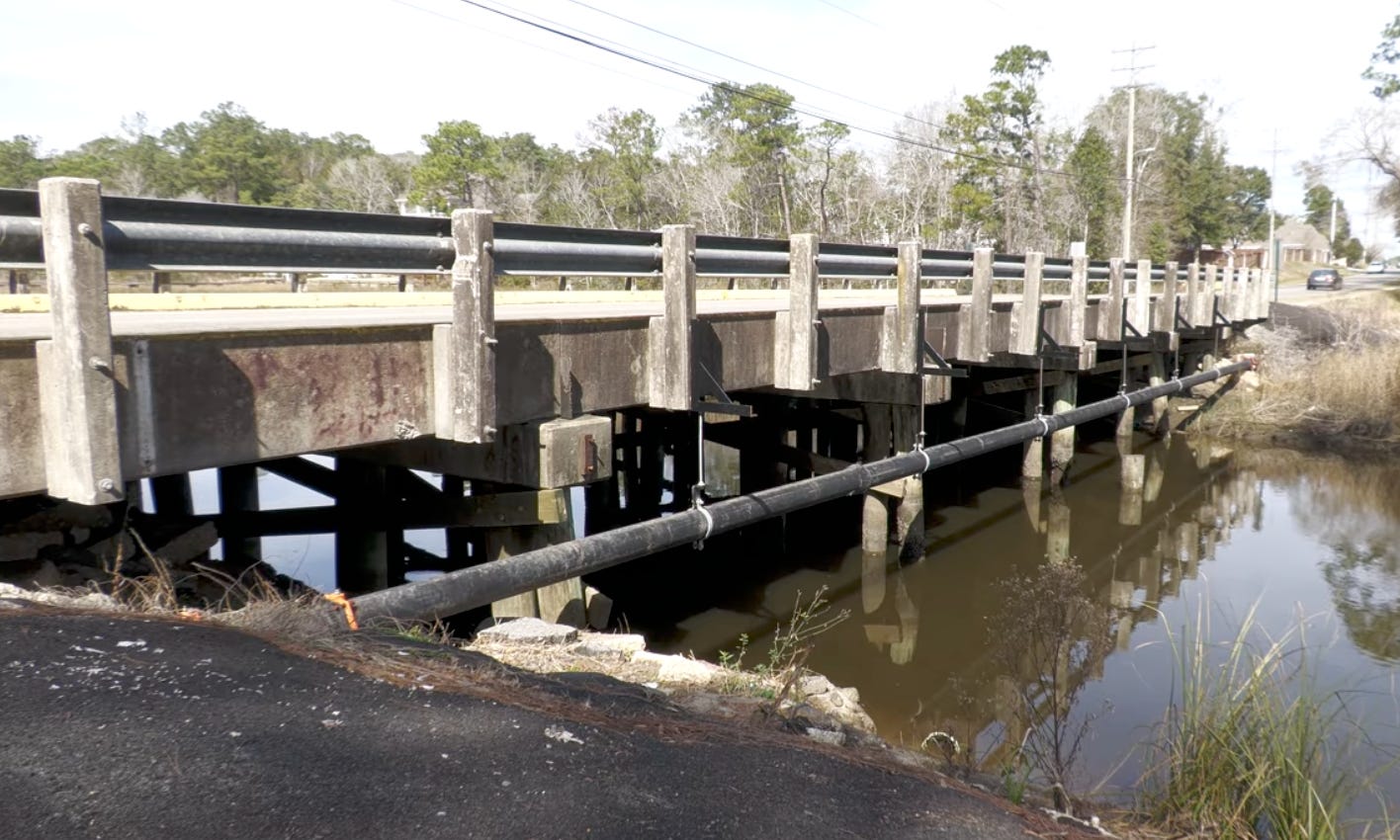
The Ethics Commission’s order stemmed from a public records request filed after the closure of the Davis Bayou Bridge on Hanshaw Road in Ocean Springs.
On March 5, 2025, the Office of State Aid Road Construction—a division within the Mississippi Department of Transportation that oversees construction and maintenance of nonstate-owned roads and bridges—ordered the bridge closed after an underwater inspection found severe deterioration in its supports.
RHCJC News submitted a public records request seeking inspection reports dating back to 2019. OSARC denied the request, citing federal law that prohibits certain safety data from being admitted as evidence in court.
The center appealed the denial, arguing that the records were requested under the Public Records Act, not for legal discovery.
In a written response dated April 23, 2025, Special Assistant Attorney General Payton W. Acy again denied the request on behalf of OSARC.
The center then filed a complaint with the Mississippi Ethics Commission, which enforces the state’s public records law.
On Jan. 22, the Ethics Commission ruled that OSARC violated Section 25-61-5 of the Mississippi Public Records Act by failing to provide the requested records.
“The Ethics Commission finds that the Mississippi Department of Transportation, Office of State Aid Road Construction violated Section 25-61-5 of the Mississippi Public Records Act by failing to provide the records requested as described in the complaint,” Executive Director Tom Hood wrote in the final order.
Vehicles cross the Davis Bayou Bridge after it reopened following temporary repairs. City officials are still seeking funding for long-term structural improvements. (RHCJC News)
The commission determined that federal law limiting the use of safety data in court does not address public access under state transparency laws and does not exempt the records from disclosure under the Public Records Act.
The commission ordered OSARC to provide a cost estimate for the requested records within seven days.
As of this publication—over a month following the order—the RHCJC News had not received a cost estimate or the requested documents.
RHCJC News also sought comment from the Mississippi Ethics Commission, requesting an in-person interview by email on Feb. 16 and Feb. 18 and calling the commission’s office on Feb. 16, 17 and 18. As of publication, the commission had not responded.
The legislation
State Rep. Steve Massengill (R-District 13) and chair of the House Transportation Committee, introduced House Bill 1660 in the days surrounding the Ethics Commission’s final order.
The Mississippi House of Representatives passed the bill 110-9.
If approved by the Senate and signed into law, the bill would exempt roadway safety evaluation records from public disclosure under the Public Records Act, including inspection reports used to assess accident risks or structural conditions.
RHCJC News requested comment from Massengill by email on Feb. 16 and Feb. 18 and called his office on Feb. 16, 17 and 18 seeking clarification on the bill’s intent. As of publication, he had not responded.
How Mississippi compares
Federal law requires states to publish basic bridge condition ratings using a 0-to-9 scoring system that measures structural condition.
State laws vary regarding whether full inspection reports—including engineer notes, photographs and maintenance recommendations—are publicly accessible.
Texas classifies bridge inspection reports as confidential under its homeland security framework.
In Pennsylvania, a 2010 Pennsylvania Supreme Court ruling held that although federal law references discovery in litigation, the intent of the statute prevents public disclosure of inspection reports.
South Carolina exempts bridge designs from disclosure unless the designs are under review in a negligence case.
In Virginia, some disclosure limitations apply specifically to critical infrastructure, generally defined as transportation assets whose failure could significantly affect public safety or economic stability.
The Roy Howard Community Journalism Center did not identify other states with exemptions identical to those proposed in House Bill 1660.
House Bill 1660 would apply broadly to roads funded through federal-aid highway programs.
The bill is now in the Mississippi Senate Accountability, Efficiency, Transparency Committee.
Image: Davis Bayou bridge (via Roy Howard Community Journalism Center)