


Shamia Hopper is a second-grade teacher at Jackson’s Midtown Public Charter School. After working in education for more than five years, she thinks back to when she was in elementary school, wondering why so many of her teachers were also working at Walmart.
“Now, as a teacher, I 100 percent understand why they worked at Walmart. We just don’t make enough money,” Hopper said.
On average, Mississippi teachers make $53,704, ranking Mississippi 51ist in the nation (including D.C.) in average teacher salary. Average starting teacher salary ranks 40th nationally at $42,492. Neighboring states Alabama, Arkansas, Louisiana and Tennessee pay their teachers on average $2,000 to $8,000 more yearly.
According to Darein Spann, president of the Mississippi Association of Educators, the primary reason for the salary disparity is simply that “when surrounding states were giving yearly raises, we were stagnant.”
The last time Mississippi teachers received a raise was in 2022. That year, when Mississippi was also ranked last in the nation in average teacher salary, the state legislature passed a bill giving them an annual raise of $5,140 and increasing starting teacher pay from $37,123 to $41,638. It represented the largest teacher pay raise in state history, but an increase in health insurance premiums and inflation rendered its impact inconsequential.
All of which has contributed to the state’s teacher shortage crisis. This summer, Jackson Public Schools held a job fair because only one-in-four teaching vacancies was filled, and results from the Mississippi Department of Education’s 2024-25 Educator Shortage survey showed 5,160 vacancies among teachers, administrators and school support staff across the state. That was an increase of 148 from the 2023-24 school year. According to the 2024-25 survey, more than 3,000 of the vacancies were teaching positions.
Many states face some form of teacher shortage, but Mississippi’s situation is acute. According to World Population Review, Mississippi ranks third out of the 36 states for which data is available in terms of the gross number of teacher vacancies. In addition to Tennessee and Alabama, both Arkansas and Louisiana report lower total vacancies as well—in the latter cases, 400 and 1,145, respectively. Despite ranking behind Florida and Georgia in the number of gross vacancies, Mississippi ranks first in vacancies per 10,000 students, with 69. A 2023 survey found that 66 percent of teachers nationwide believed they were receiving an inadequate salary for their work. It seems logical that such perceptions would be more pronounced in the state with the lowest teacher salaries.
The minimum living wage, the income needed for one adult and one child to have a modest standard of living, is $62,865 for the most affordable metro area in Mississippi–almost $10,000 more than the state’s average teacher salary. Once insurance premiums and taxes are factored in, what teachers actually bring home in salary paints an even bleaker picture.
After she moved back to Mississippi from Florida, Hopper said she immediately felt the impact of the change in her teaching salary. While in Florida, she worked as an after-school director, and she also had a part-time job in retail. The combined income alone enabled her to take care of her day-to-day living expenses and continue paying the mortgage on the home she owned in Mississippi. Upon moving back to her home in Mississippi, she expected to have increased financial flexibility while still working in education but without having to pay her Florida apartment rent on top of her mortgage. However, the change in salary combined with an unexpected $400 increase in home insurance costs compelled her to pick up second and third jobs at Under Armour and a local bar.
As an advocate for educators, Spann recognizes that educators never really saw the raise they received in 2022, and through his work with MAE, he’s continuing to beat the drum and advocate for teachers to receive a living wage.
“Educators should not be struggling to make ends meet,” Spann said. “We have a high demand on us that is very important to the future of this state, and it should not be taken lightly.”
Lydia Robbins is a first-year, fourth-grade special education teacher at Central Elementary School in the Oxford School District. She works with 22 kids and whenever she doesn’t have a group in her classroom, has to devote time to tedious paperwork to meet the legal requirements for 16 of her students.
As a fourth-generation teacher, Robbins says she has always had a passion for education, and ultimately found her niche in special education. However, as a first-year teacher, she makes around $5,000 less than the state average for teachers and has begun to question if she chose the right career path.
“Just long-term, it’s not realistic anymore, especially in the economy we’re living in,” Robbins said.
The recent growth that Oxford has seen has caused house prices in the region to surge. For Robbins, this has resulted in rent consuming half of her paycheck each month, causing her to feel stuck financially. “I don’t have the financial flexibility to do a lot of things I want to do,” she said. “I’m starting to look around and I’m realizing that everyone is financially moving on and moving past me a lot quicker.”
Like Hopper, Robbins has picked up additional work, working as a bartender and manager at a local restaurant. Working late nights at the restaurant, getting up at 5:30 a.m. throughout the week, and being the attentive presence her students need have resulted in Robbins feeling chronically exhausted. Though she acknowledges that the first year in education is often the worst, she can’t help but feel that her pay as a teacher doesn’t reflect the work she does.
While teaching is the primary hat that educators wear, it is just one of many that they find themselves putting on. Out of her class of 20 second graders, Hopper only has five that are at a grade-appropriate reading level and only eight that are on grade-level in math. In addition to having a majority of students who are not on grade level, she has some who are incapable of counting to 100, which is typically a kindergarten-level skill. She does all she can in the time she has them in the classroom, and she believes that education “truly does begin at home.” Yet Hopper, who is 29 and has no children of her own, said many of her students’ parents are around her age and look to her for guidance, not only for their children’s education but for their overall development.
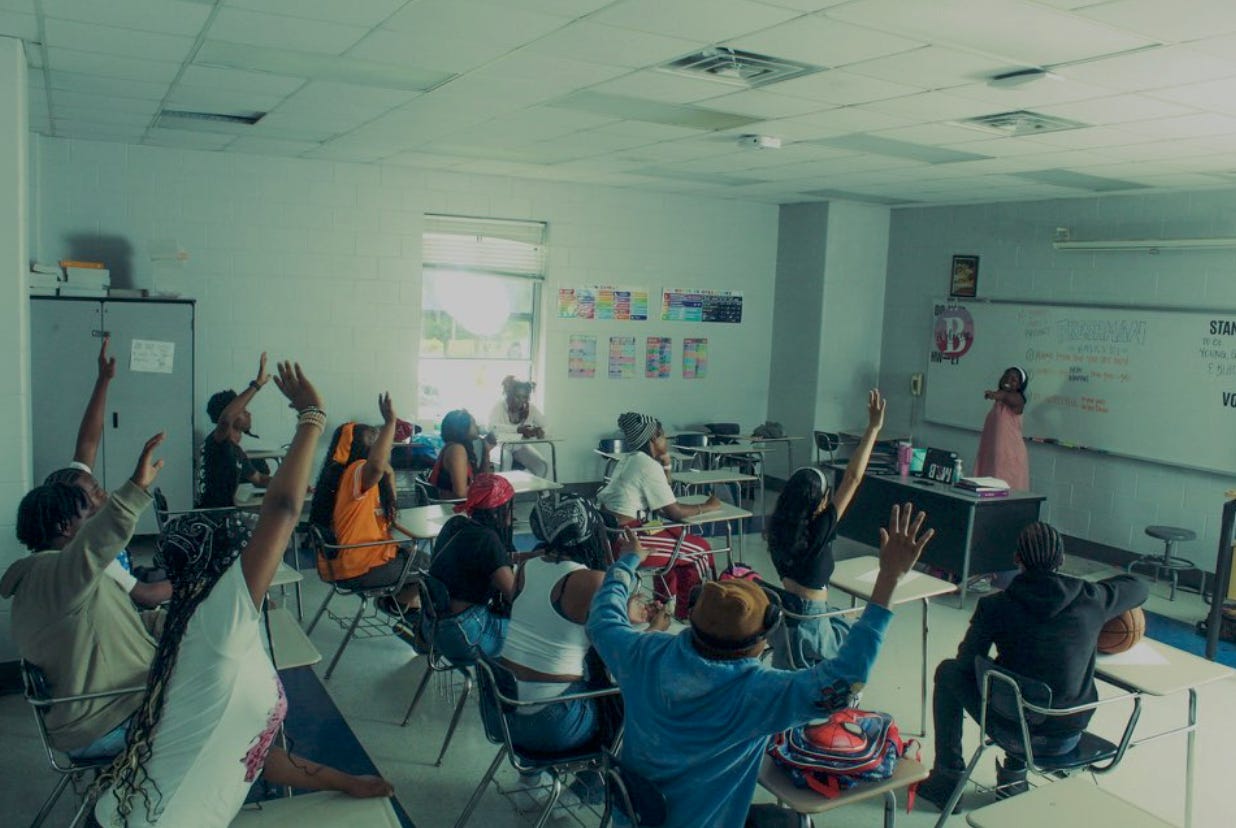
Teaching 8th grade world geography at Peeples Middle School in south Jackson, Lauren Brown has shared the experience of being more than a teacher for her students. In fact, it is what drew her to the school. She recalled wanting to go to Peeples to show students “they’re bigger than that area that they’re in” and to try to instill in them a positive personal narrative.
Brown gets to school every morning around 7:30 a.m. to help with carpool and bus duties and greet students as they come in. Students at Peeples (there are about 300) begin every day with W.I.N. (“Whatever I Need”) time to help them in specific areas where they may be struggling, such as writing and math. After this dedicated improvement time, Brown sees four blocks of classes over the course of the school day. In between, and even during these blocks, she is tasked with handling whatever the day brings, whether that’s developing her students’ minds, crisis management or teaching them life skills they need to survive and thrive outside of the classroom. As she put it, “Not only am I teacher, but I’m somebody’s therapist. I play mom a lot. I am somebody’s nurse because we don’t have a nurse in the school. There’s many different roles that I’m being thrown at while having to teach, having to play referee when there are fights, having to be a mandated reporter.”
All of these challenges have contributed to a significant staff shortage, Brown said.
The MAE’s Spann commended educators for the teaching and learning that takes place despite the challenges that have contributed to the teacher shortage. He noted that on the National Assessment of Educational Progress assessment, Mississippi students showed significant gains for 4th and 8th grade math, which represents an improvement from 49th to 16th in the nation.
Still, Hopper noted that schools are not currently equipped with the resources teachers need to meet students’ individual needs. This is especially the case for students with learning disabilities and other challenges. For autistic kids at Midtown Public Charter School, there is no extra staff person in the room to accompany them and ensure that they are grasping what they are learning.
The educator shortage is expected to be exacerbated by changes the Mississippi Legislature made to the public employee retirement system. Teachers who start after March 1, 2026, will have their retirement tenure extended from 30 to 35 years, with no guarantee of cost of living raises. Overall, low wages and now, decreased benefits have made it more difficult to recruit and retain teachers.
For many educators, their work is their passion. But with the daily challenges and demands of being a teacher, all three teachers who spoke with The Mississippi Independent said although they plan to continue working in education, it may not be in a classroom setting.
Hopper said she told herself in November, “This is definitely my last year teaching.” She’s looking to move into a leadership role, whether that means consulting with a school or guiding professional development. Whatever she does, Hopper said, she doesn’t want “to keep working three jobs just to meet the baseline.”
Image: Lauren Brown teaching at Peeples Middle School (courtesy Lauren Brown)
