


As Republican-led states move to eliminate majority-Black congressional districts after the Supreme Court’s decision in Louisiana v. Callais, conservatives in Mississippi have made an argument about what those districts are. The districts sort voters by race, they say, and dismantling them ends the sorting.
U.S. Rep. Bennie Thompson and the civil rights organizations defending his seat answer that the districts remedy racial discrimination and that removing them revives it. The two sides do not dispute that race shaped the maps. They disagree about which use of race the Constitution forbids.
State Auditor Shad White has put the conservative case in those terms.
“Congressman Thompson’s congressional district was specifically drawn along the lines of race, and to me that is a form of racial bias,” White told Action News 5 (Memphis), calling for the Second District to be redrawn.
Former state senator Chris McDaniel made the same argument in a post on the decision, describing the majority-Black districts as racial carveouts that divide towns and split counties to group people by race, and saying the maps should follow communities and geography instead.
Thompson, who has held the Second District since 1993, answered the charge directly. “Bennie Thompson will be there with a whole bunch of folks with bells on, saying that this is not who we are,” he told Action News 5. “‘Jim Crow 2.0’ shouldn’t exist.”
Earlier, on Al Sharpton’s program, Thompson described the district as a consolidation rather than a division, saying the Voting Rights Act let lawmakers “craft a district” that could elect a Black member of Congress and that Black “communities of interest were consolidated and not divided” under the prior reading of Section 2.
During a Jackson rally on May 21 against weakening the Voting Rights Act, Thompson said: “The reason I act the way I do is because I was mistreated along the way. The mistreatment isn’t something I wanted to happen. It’s because the system didn’t want people like Bennie Thompson and you to make it.”
The disagreement over the constitutionality of district lines drawn to enable the election of Black candidates is the one the Supreme Court decided. The issue of the constitutionality of district lines drawn to favor white candidates by diluting Black voter strength was not before the court.
Writing for the six-justice majority on Apr. 29, 2026, Justice Samuel Alito held that the Voting Rights Act “was designed to enforce the Constitution—not collide with it,” and that lower courts requiring majority-Black districts had engaged in “the very race-based discrimination that the Constitution forbids.” The Constitution, Alito wrote, “almost never permits the Federal Government or a State to discriminate on the basis of race.” In that reading, the majority-Black district is the racial classification, and Section 2 had been forcing states to make it.
The three dissenting justices located the racial harm elsewhere. Justice Elena Kagan, joined by justices Sonia Sotomayor and Ketanji Brown Jackson, wrote that under the majority’s standard “a State can, without legal consequence, systemically dilute minority citizens’ voting power,” and that the majority’s changes “eviscerate the law.” In the dissent’s account, the racial classification is the dilution the district was drawn to prevent, and Section 2 was the remedy.
The record behind Thompson’s seat tracks the dissent’s account. Majority-Black districts in the South were largely ordered by federal courts, or drawn by legislatures under court supervision, after judges found that existing maps diluted Black voting strength. The Second District took its Delta-anchored, majority-Black shape from Section 2 litigation in the early 1980s and first elected a Black congressman, Mike Espy, in 1986, the first Mississippi had sent to Washington since 1883. The district that the conservative argument characterizes as a racial carveout entered the record as a remedy a court imposed after finding racial discrimination.
The fight has moved beyond the courtroom. After Callais, Tennessee passed a new map eliminating a majority-Black district in the Memphis area, and Alabama and Florida moved to redraw their lines. The NAACP responded by calling on Black student-athletes to boycott colleges in Southern states redrawing their maps, a campaign amplified by the Congressional Black Caucus and House Democratic Leader Hakeem Jeffries. Most of the targeted schools are in the Southeastern Conference, which includes Mississippi’s two largest universities. Today, May 27, 2026, hundreds gathered in Jackson at a march organized by the NAACP, the Southern Poverty Law Center and the Mississippi Democratic Party. Thompson told the crowd the Voting Rights Act had allowed “people that looks like me” to become mayors and sheriffs across Mississippi. “You have to understand that the system is not fair,” he said.
The Mississippi Legislature has not redrawn the Second District. Gov. Tate Reeves has said he wants the seat gone and has twice declined to call a session to draw it. Whether a new map ends racial sorting or revives vote dilution is the question Callais decided, in a vote of 6-3, and the one every southern legislature now redrawing its lines will test again.
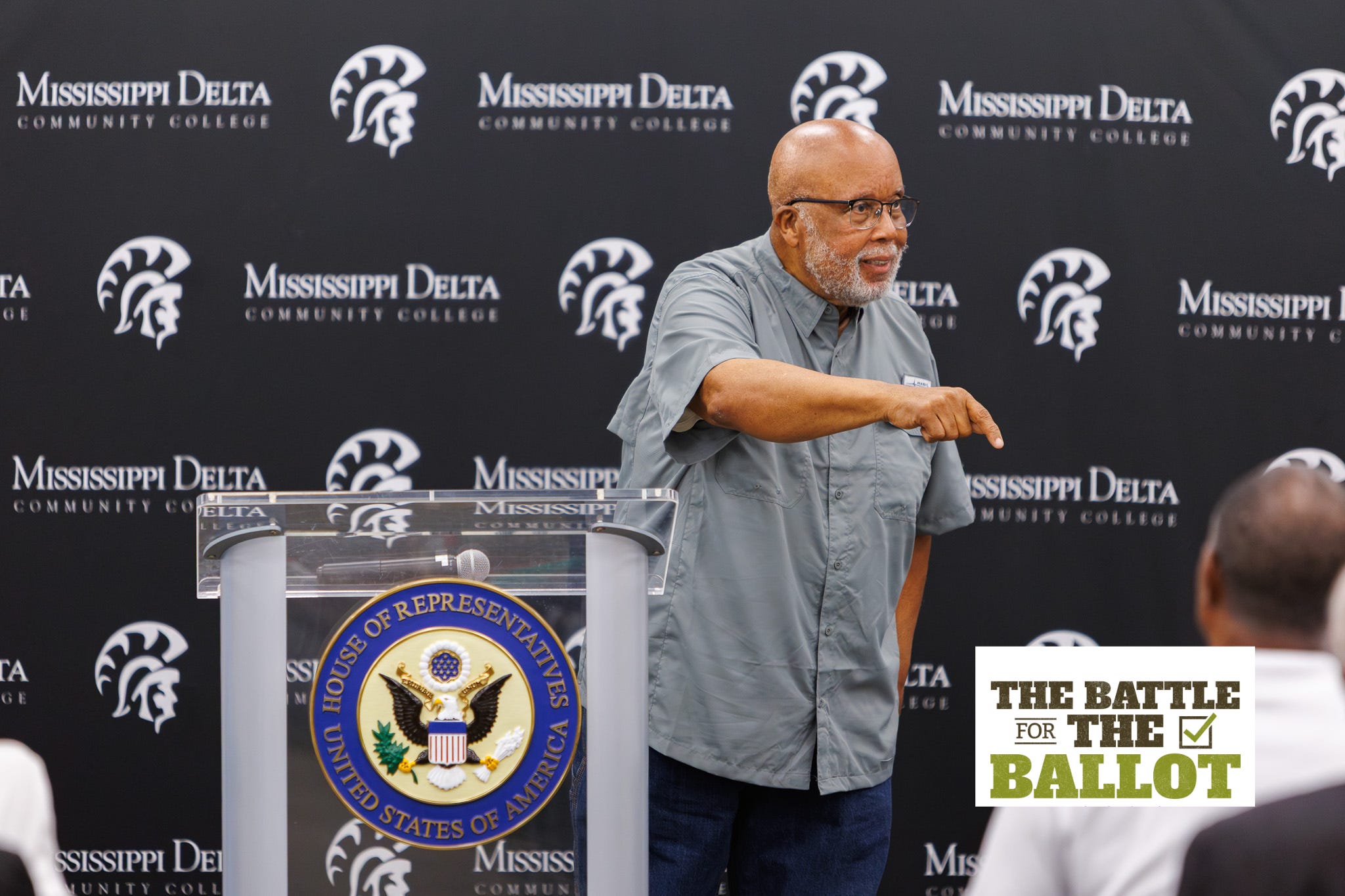
Image: U.S. Rep. Bennie Thompson (via his offical Facebook page)
