


Mississippi’s funding formula for colleges and universities will remain in place for now after the Board of Trustees of the Institutions of Higher Learning met Thursday, Aug. 20, without taking up a proposed performance-based funding model.
IHL, the board that governs Mississippi’s eight public universities voted June 18 to move toward a funding formula that would tie state dollars to graduation rates, student retention and how much graduates earn.
Some lawmakers have warned that measuring universities this way could penalize Jackson State University, Alcorn State University and Mississippi Valley State University because the metrics take no account of the decades those schools went underfunded by the state.
(More after the video)
Under the timeline the board set in June, the model returns for discussion at its annual retreat on Sept. 17 and 18 in the Hattiesburg area, following a round of feedback from university staff on the plan’s performance-funding categories—Excellence Funding, Improvement Funding, and Administrative and Financial Efficiency Funding—layered atop a foundational “floor” meant to cover each institution’s basic operating needs.
The formula will shape the budget requests IHL sends to the legislature, where lawmakers who shelved their own version this year plan to return to it in 2027. Its sharpest stakes fall on Jackson State, Alcorn State and Mississippi Valley State, HBCUs that critics warn the performance metrics could penalize for the decades those schools went underfunded—the disparity at the heart of the Ayers case.
That underfunding is documented. In 1975, Jake Ayers Sr., a civil rights activist from Glen Allan, sued Mississippi on behalf of his son, a Jackson State student, arguing that the state ran one system of higher education for white students and another for Black students. The suit became a class action. The United States intervened, as did Bennie Thompson, who later was elected to Congress representing the 2nd District. The case went to trial in 1982, the U.S. Supreme Court ruled on it in 1992, and in 1995 a federal district court found that vestiges of segregation remained in the state’s university system.
Mississippi settled in 2002, over the objections of the Ayers family, agreeing to pay $503 million during 17 years to the three universities. The package included $246 million for academic programs, $75 million for buildings, a $70 million public endowment and a $35 million private one. The universities could not draw on the endowment income until each campus enrolled at least 10 percent non-Black students for three consecutive years.
The state’s obligation ended in 2022.
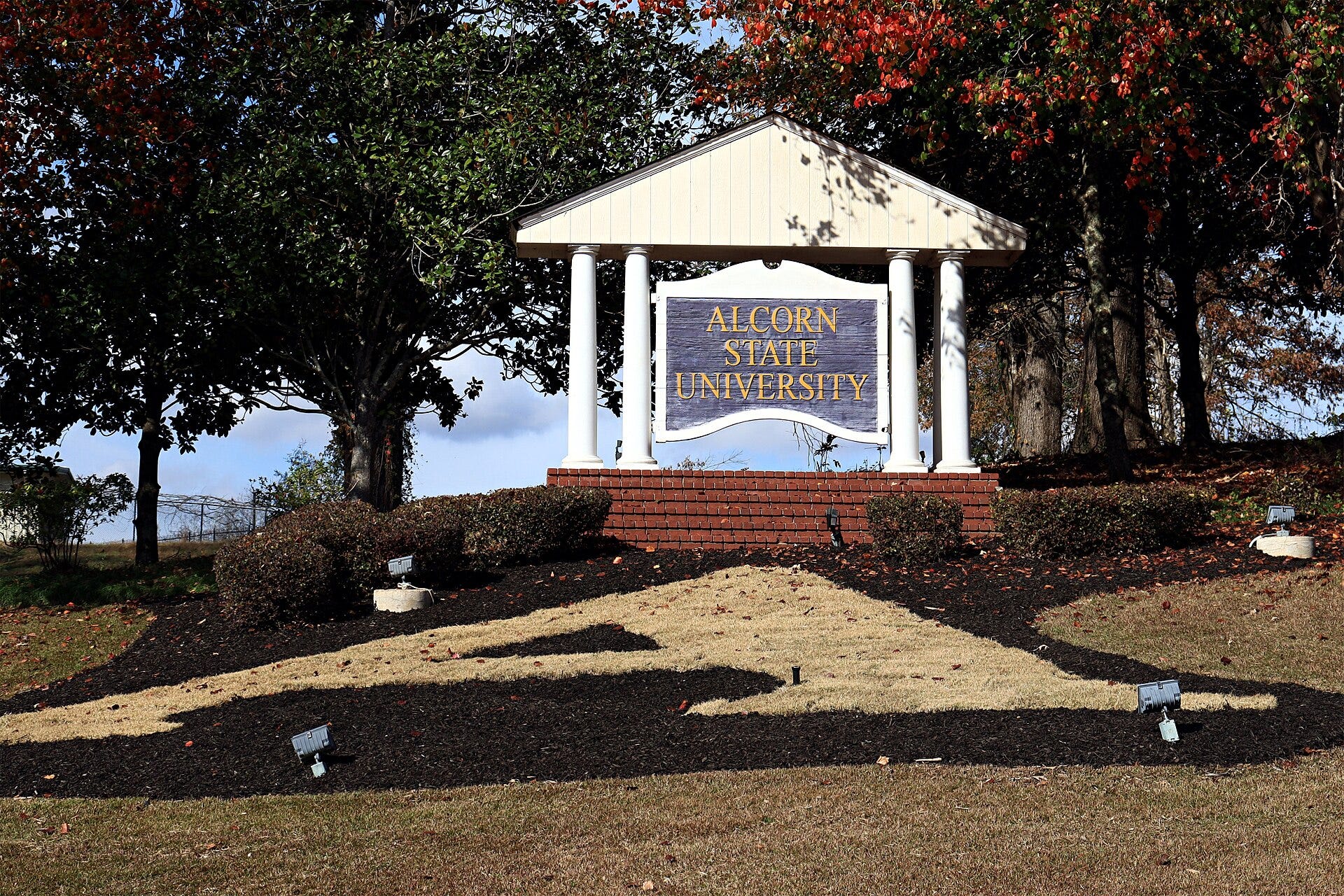
Image: Alcorn State University welcome sign near Lorman (via Wikimedia Commons)