


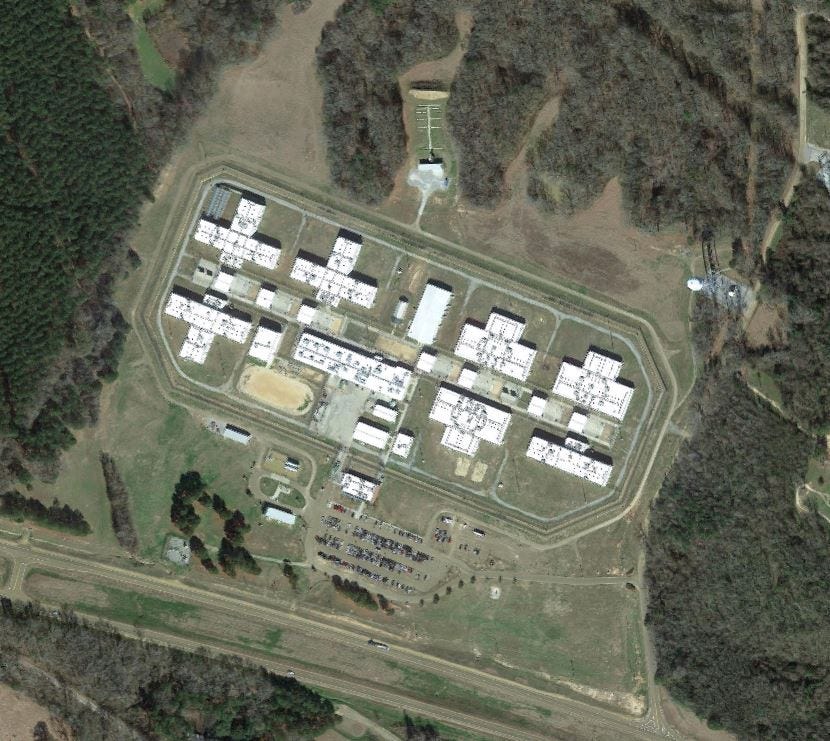
CoreCivic and the federal Immigration and Customs Enforcement agency, or ICE, have partially dismantled an alleged, yearslong predatory scheme that exploited immigrants released from one of the nation’s largest detention centers, following an investigation by The Mississippi Independent.
CoreCivic, which operates the Adams County Correctional Center outside Natchez, said it reviewed questions raised by the investigation that one of its senior detention officers had since at least 2020 helped steer released detainees to a taxi service operated by the officer’s husband, Otis Anderson. Former detainees and immigration advocates have accused Anderson of using threats and charging fares of more than $300 per passenger. His service was repeatedly selected despite cheaper alternatives, including free transportation offered by regional nonprofit groups, though CoreCivic has not explained how detainees made those choices.
While the for-profit company said it was unable to confirm the allegations against its employee, Tameka Moore-Anderson, it said it had taken steps intended to prevent any future improprieties.
“We take seriously our responsibility to adhere to all applicable detention standards and policies that our government partners expect of us at our Adams County Correctional Center (ACCC), as well as our own CoreCivic policies and procedures,” Ryan Gustin, CoreCivic’s senior director of public affairs, said in an email to The Mississippi Independent. “While we have not substantiated any of these claims, additional measures to ensure that there is no conflict of interest have been taken.”
The company did not say whether Moore-Anderson, a lieutenant who works in the unit responsible for discharges and arranging onward transport for released detainees, had been removed from duties due to the accusations.
Gustin also said that ICE stopped offering Anderson’s service as a transportation option to released detainees in response to The Mississippi Independent’s investigation.
Years of costly rides
The Mississippi Independent, reporting in collaboration with the Spanish-language newspaper El Molino Informativo, found that Anderson had for years charged immigrants hundreds of dollars each for rides from the Adams County facility to transportation hubs in Mississippi and Louisiana, according to text messages between Anderson and detainees’ relatives, accounts of former passengers and interviews with longtime immigration advocates who had dealt with him directly.
In April 2026, Anderson allegedly charged $900 to drive three released detainees from Adams County to the airport in Baton Rouge, Louisiana, according to a juvenile passenger who spoke with El Molino. The journey is approximately 75 miles. The juvenile said he had asked to be taken only to the bus station in Natchez, approximately 12 miles from the detention center. At the time of the reporting, Uber estimated that a trip from the detention center to the Baton Rouge Airport would cost approximately $110.
The juvenile also said Anderson threatened to have him returned to detention if he refused to pay. Anderson has declined to address the allegations, instead asking The Mississippi Independent not to contact him again. Moore-Anderson has not responded to repeated questions about whether she helped direct detainees to her husband.
CoreCivic previously said it has no contracts with private transportation companies providing such rides and received no financial benefit from the services used by detainees.
Unexplained transportation list
CoreCivic’s statement leaves a central question unresolved.
ICE said it removed Anderson’s taxi service from a list of taxi services. But Anderson’s company does not appear on either of the two lists obtained by The Mississippi Independent, one from 2022 and another from November 2025.
CoreCivic did not provide the list that it referred to nor explain when Anderson’s service had been added.
The discrepancy also does not explain how Anderson repeatedly obtained passengers from inside the detention center or collected groups of immigrants in a large passenger van, which a fellow taxi driver in Natchez said he witnessed.
Anderson owned a 15-passenger van until October 2024, according to online records.
Immigrants in detention have limited access to phones and the internet. Their only access to transportation options would have been on the ICE-approved taxi lists given to them by CoreCivic staff as they prepared for release. Likewise, their relatives and legal representatives—independent and scattered across the United States and abroad—make it unlikely that any of them would be able to coordinate a group collection of detainees.
Those circumstances raise the possibility that someone with access to the detainee release process arranged for Anderson to collect groups.
CoreCivic previously said that when ICE orders a detainee released directly from Adams County, facility employees provide information about local transportation options to help the person reach a preferred destination.
“Individuals are free to make their own transportation arrangements, including those arranged by their legal representatives,” the company said in a previous statement to The Mississippi Independent.
Federal transportation requirements
Immigration advocates explained to The Mississippi Independent that the taxi exploitation scheme has been fueled by CoreCivic and other detention operators failing to follow ICE’s Performance-Based National Detention Standards stringently.
The rules govern conditions and operations at privately operated and government-run immigration detention facilities and cover matters ranging from food service and sexual-assault prevention to marriage requests and release procedures.
Since at least 2021, immigrant advocacy organizations have complained to the federal government that detention centers in Louisiana and Mississippi routinely fail to follow provisions requiring facilities to transport certain released detainees to public transportation.
Under the standards, when a facility is more than one mile from public transportation, officials must ordinarily provide transportation so that a detainee can reach a bus, train or other transit service before it stops operating for the day.
Gustin said an ICE detention-standards compliance officer stationed at Adams County monitors CoreCivic’s adherence to federal requirements.
“All our facilities are subject to robust oversight and accountability measures,” Gustin said. “Our government partners all require regular review and audit processes.”
Reports by other outlets indicate that some private contractors have successfully lobbied ICE to revise the standards in ways that benefit their bottom lines.
The standards do not say anything about taxis or indicate that detainees purchase taxi rides as a substitute for the facility’s obligation to deliver them to public transportation.
The Mississippi Independent has found that high-priced taxi services are common around remote immigration detention centers in Louisiana and Mississippi, where public transportation is scarce and released detainees often have few alternatives.
Potential conflict of interest
Gustin said CoreCivic had reminded Moore-Anderson of company policy in the aftermath of The Mississippi Independent investigation.
“We have reviewed all applicable policies and procedures with the staff member cited in your inquiry,” Gustin said. “We have verified that our staff members are not listed as part of the ownership of Anderson and Son Transportation.”
A formal ownership stake, however, is not the only element of a potential conflict. A central question that remains unanswered is whether Moore-Anderson used her position, access to detainees or role in the release process to benefit a taxi service operated by her spouse.
CoreCivic’s ethics code requires employees to disclose potential conflicts involving government work and allows the company to discipline employees for violations. Federal contracting rules also require covered contractors to maintain ethics and internal-control systems designed to detect similar improper conduct.
Despite ICE’s decision to stop offering Anderson’s service, Gustin said it does not stop Anderson from being hired independently.
“It’s worth noting that those individuals in our care, family members, advocates or legal representatives could still independently contact this company to arrange transportation services,” Gustin said.
Image: Aerial view of Adams County Correctional Center (via Flickr/Creative Commons)

Yes, I’m sure Core Civic and ICE are going to do s*it.