


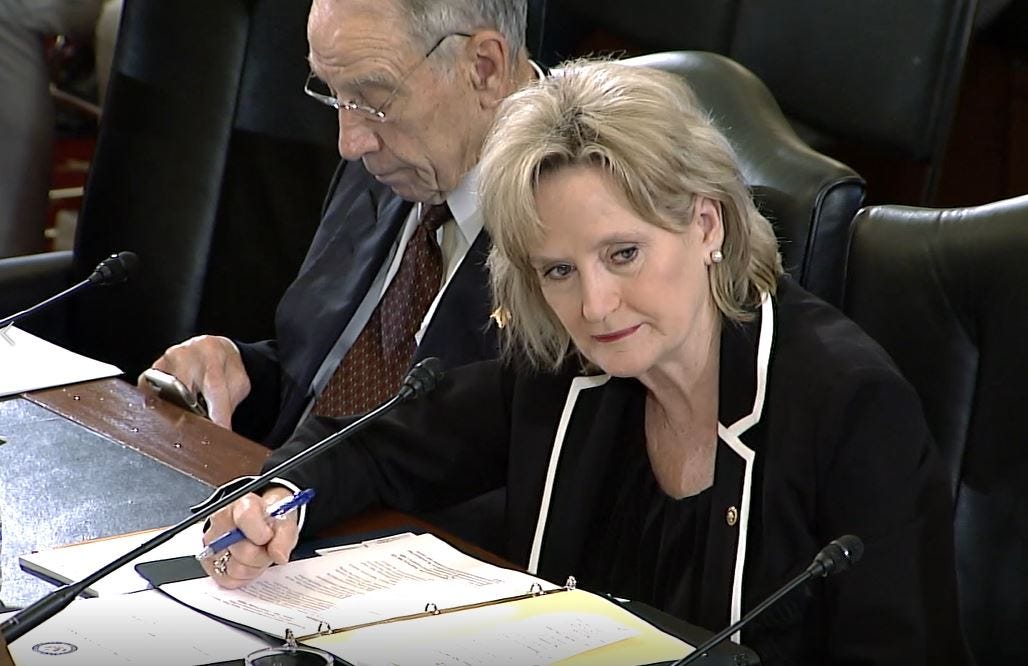
U.S. Sen. Cindy Hyde-Smith joined fellow Republican lawmakers this week to table an amendment that would have banned senators and their spouses from trading stocks, blocking a debate on the ethics measure without a vote on its merits.
The vote in the Senate Rules and Administration Committee fell along party lines, 9-8, with all Republicans voting to table and all Democrats voting against. Hyde-Smith, who serves on the committee, did not speak during the proceedings but voted with her party to kill the amendment.
The amendment, offered by Sen. Jon Ossoff (D-Ga.), would have prohibited senators from trading individual stocks within one year. Ossoff said the language was drawn from bipartisan legislation that already passed the Senate Homeland Security and Governmental Affairs Committee earlier this year but has not received a floor vote.
“The American people expect their elected representatives to put the public interest first, not our private financial interest,” Ossoff said during the hearing. “And yet time and again, we hear about members of Congress in both political parties trading stocks like that’s their day job, rather than representing the constituents who should be our highest priority.”
Ossoff noted that “overwhelming majorities of Democrats, Independents, Republicans want to ban stock trading by members of Congress,” and accused unnamed senators of privately lobbying leadership to prevent a floor vote on the issue.
Sen. Jeff Merkley (D-Ore.), spoke in support of the amendment, asking colleagues to allow debate before any motion to table.
“There is no way if you have a huge portfolio concentrated in a particular area or you have a specific stock that would be affected by legislation, there isn’t a voice in your head recognizing that and perhaps exercising some influence over how you might act,” Merkley said.
A motion to table effectively kills an amendment without requiring senators to vote directly on the underlying policy. The procedural move allowed Republicans to block the stock trading ban without going on record as opposing it outright.
Hyde-Smith’s office did not respond to repeated requests for comment.
Hyde-Smith faces reelection in 2026. Her likely Democratic opponent, Lowndes County District Attorney Scott Colom, criticized the vote.
“No politician should be able to go to D.C. and get rich off of public service,” Colom said, adding that Hyde-Smith “voted to let politicians like herself enrich themselves” and called it an example of the senator “putting herself and wealthy politicians first.”
Colom said he supports banning members of Congress from trading stocks.
Congressional stock trading has drawn bipartisan criticism in recent years. In July, the Senate Homeland Security Committee advanced legislation to ban stock trading by members of Congress on an 8-7 vote, with Sen. Josh Hawley (R-Mo.) joining Democrats in support. [Optional revision: In July, the Senate Homeland Security Committee voted 8–7 to advance legislation banning stock trading by members of Congress, with Sen. Josh Hawley (R‑Mo.) joining Democrats in support.] That bill has not received a floor vote.
The Rules Committee approved the underlying resolution, S.Res. 526, which would withhold senators’ pay during government shutdowns. That measure now heads to the full Senate.
Image: U.S. Sen. Cindy Hyde-Smith (via her Senate website)

While I don't care for Hyde-Smith there is a reason why the Republicans are opposed to the legislation. The bill would restrict the President and Vice President from insider trading and as I understand the legislative branch cannot impose this restriction on the executive branch. The bill as it is appears to be Illegitimate. The executive branch is already restricted from insider trading by the STOCK Act.