


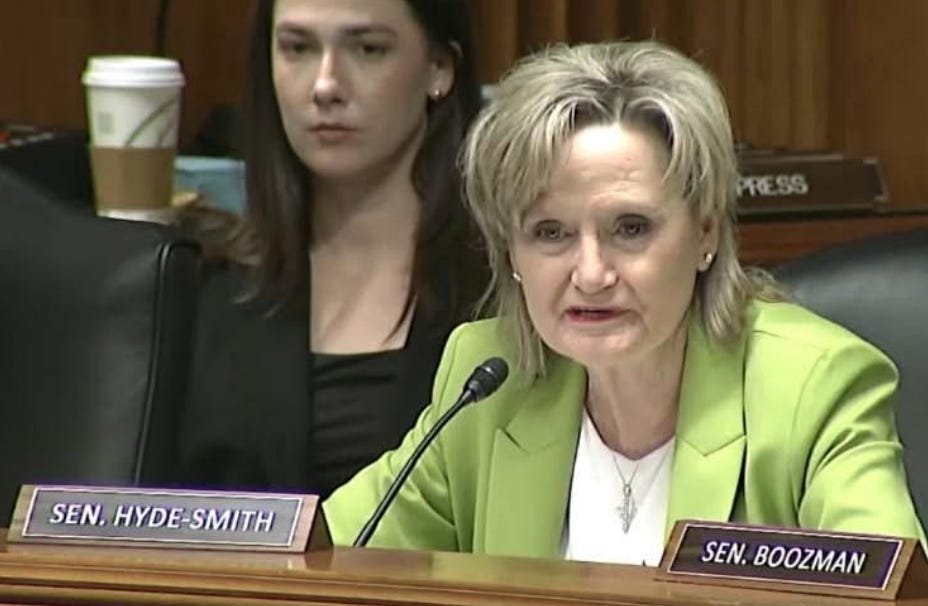
In a recent Facebook post, U.S. Sen. Cindy Hyde-Smith touted having questioned Health and Human Services Secretary Robert F. Kennedy Jr. at a Senate subcommittee hearing about the Medicare Area Wage Index, a federal reimbursement formula that Mississippi hospitals have long argued undercuts their payments relative to hospitals in higher-wage regions of the country.
The wage index sits within a broader set of financial pressures that Mississippi hospitals face, in part due to federal legislation that Hyde-Smith voted to support. The One Big Beautiful Bill Act, H.R.1, which President Trump signed in 2025 and which Hyde-Smith and fellow Mississippi Republican Sen. Roger Wicker backed, includes cuts to state-directed payments that help hospitals offset low Medicaid reimbursement.
“The healthcare industry in Mississippi is poised to lose hundreds of millions of dollars over the next few years from some cuts that came about through the One Big Beautiful Bill Act,” said Richard Roberson, president and chief executive officer of the Mississippi Hospital Association.
Mississippi Medicaid Director Cindy Bradshaw has estimated the state stands to lose approximately $160 million a year in such payments beginning in 2029.
In her exchange with Kennedy at a Senate Labor, HHS and Education Appropriations Subcommittee hearing on April 21, 2026, Hyde-Smith said Forrest General Hospital, a Level II trauma center in Hattiesburg, had to absorb an $8 million annual loss as a result of the Medicare disparity, and warned that continued pressure from the formula could weaken the 19-county rural network serving roughly 700,000 Mississippians.
“The wage area index is destroying rural areas in this country, and we know it’s a problem,” Kennedy responded. He said the Trump administration has shown a willingness to work with Congress on a budget-neutral solution, a requirement for the Area Wage Index under the Social Security Act, which means that giving more to one region requires taking from another.
Hyde-Smith’s exchange with Kennedy came as Mississippi’s rural hospital sector absorbed a series of financial blows during the last several months. Greenwood Leflore Hospital filed for Chapter 9 bankruptcy on April 15, the first bankruptcy in the 120-year history of the Delta hospital, which is jointly owned by the City of Greenwood and Leflore County and which last week laid off 86 employees, discontinued four services and warned employees of potential full closure on June 15. Franklin County Hospital in Meadville lost its Critical Access Hospital designation from the Centers for Medicare and Medicaid Services in January, a status Hyde-Smith worked to restore through language she secured in the fiscal year 2026 federal appropriations package signed by the president on February 3.
Hyde-Smith has gone to bat for rural hospitals in other ways. She is the lead sponsor of the Rural Health Sustainability Act, which she introduced in the 118th Congress and reintroduced as S.1800 in May 2025, modifying the CMS Rural Emergency Hospital program to make more at-risk or closed rural hospitals eligible for the designation and its enhanced Medicare reimbursement rates. She is an original cosponsor of the Save Struggling Hospitals Act, S.4233, which would codify the Medicare low-wage index policy she referenced in the Kennedy hearing, and she worked with Sen. Jeff Merkley (D-Ore.) to establish the CDC Office of Rural Health in 2023.
Roberson credited Hyde-Smith with the Franklin County save. “Sen. Hyde-Smith was very instrumental in helping push through a bill that extended the critical access hospital designation for Franklin County that did essentially save that hospital for that community,” Roberson said. He added that the hospital’s specialty-- weaning ventilator-dependent patients off support so they can return home--draws patients from across Mississippi and from other states.
Roberson also confirmed that the Medicare Area Wage Index problem Hyde-Smith raised with Kennedy is a significant federal lever and needs to go up. Mississippi, he said, is one of the lowest, if not the lowest on the index. “That prohibits us from being able to recruit across state lines,” he said. “That’s a federal issue.”
The Big Beautiful Bill Act created a five-year, $50 billion Rural Health Transformation Program intended to partially offset the losses that resulted from its passage, and Gov. Tate Reeves unveiled Mississippi’s application for the program in November 2025. The state’s plan does not include direct financial assistance to hospitals, which the federal government has indicated it will not approve. Reeves said at the announcement that every facility in the state would need to continue to think through what its business model looks like, and that he hoped the transformation funds would lead to efficiencies.
Roberson said that provision is not a panacea. “The rural health transformation funds can help offset a little bit of that, but it’s not going to all go to hospitals, and we know that,” he said. “Any additional cuts that might come down the line, we’re kind of at the point now, we’re cutting to the bone.” He added: “It’s a five-year program, and last I checked, most people’s life expectancy is going to exceed the next five years. They’re gonna need a health care system to take care of people.”
Medicaid is a central part of Mississippi hospital revenue. Roberson said the Medicaid program and Medicaid-managed care plans together account for roughly 20 percent of hospital revenue and 20 percent of hospital patients statewide, with Medicare and Medicare Advantage accounting for another 40 to 45 percent. Hospitals across the state draw between 60 and 70 percent of their revenue from government payers whose reimbursement rates hospitals do not negotiate. Commercial insurance, which hospitals can negotiate with, accounts for a smaller share.
“Medicaid is a vital piece of the healthcare puzzle in Mississippi and for our hospitals,” Roberson said. “It’s a big chunk of what our hospitals rely upon for payment, and what all of us, even if you’re not on Medicaid, you want to make sure that whoever is paying the bill is able to pay it, because that gets spread out across all of us as taxpayers, too, and all of us as patients.”
Mississippi has not expanded Medicaid under the Affordable Care Act. Expansion would extend coverage to an estimated 300,000 working Mississippians. Multiple expansion bills were filed during the 2026 legislative session but all died without being brought up for a vote by the Republican legislative leadership. Hyde-Smith has consistently said the decision on expansion rests with the governor and state lawmakers, a position her 2020 campaign tied to the 2012 United States Supreme Court ruling in National Federation of Independent Business v. Sebelius, which held that the federal government could not compel states to expand the program.
The One Big Beautiful Bill Act, which Hyde-Smith supported, removed financial incentives the Biden administration had created to encourage the remaining non-expansion states to take up the program.
Greenwood Leflore Hospital’s financial difficulties long predate its April 15 bankruptcy filing. Roberson described the hospital’s declining revenues as shaped in part by its earlier decision to close labor and delivery services, a decision that came before a subsequent increase in Medicaid supplemental payments for those services made the service line more financially viable.
“The number of babies born with Medicaid coverage in Greenwood when they were delivering babies was probably over 90 percent,” Roberson said. “They got rid of that service because it is expensive to pay for those providers and provide those services, and then a year or two later Medicaid became one of the best payers for that service when the supplemental payment program grew. By the time you make the decision to divest of those services, those providers leave. They go to other relationships with other hospitals or leave the state entirely in some cases. It’s hard to bring those services back once they’re gone.”
Greenwood Leflore faced a very small commercial payer mix, Roberson said, “and so the margins are just really tough.”
The Mississippi Division of Medicaid began clawing back millions of dollars in Medicaid overpayments made to Greenwood Leflore in 2024 following a recalculation of the hospital’s patient volumes, adding to the pressures that drove the legislature this session to pass S.B.3230, which authorized the hospital to file for Chapter 9 bankruptcy. The bankruptcy filing is meant to give the hospital time to negotiate a possible transaction with the University of Mississippi Medical Center while continuing to provide services.
Roberson said the larger pattern affecting hospitals is the recurring shift in federal policy direction.
“We would love government to say, look, this is what we want our healthcare system to look like, y’all go make it happen,” Roberson said. “We got some smart people out there in healthcare. Whether they’re physicians and nurses and administrators, they’ll figure it out. But when we keep changing these things every two, four, six, eight years, that’s when things get wonky.”
Hyde-Smith is up for reelection in November 2026. Her office did not respond to a request for comment on the relationship between her advocacy for Medicare Area Wage Index revision and her vote for the One Big Beautiful Bill Act. The Mississippi Legislature is not scheduled to reconvene on Medicaid expansion until its 2027 session, by which time Greenwood Leflore’s bankruptcy proceedings will have moved further through the courts and Franklin County Hospital’s Critical Access designation will be up for renewed federal review.
Image: U.S. Sen. Cindy Hyde Smith (via her official Facebook page)
