


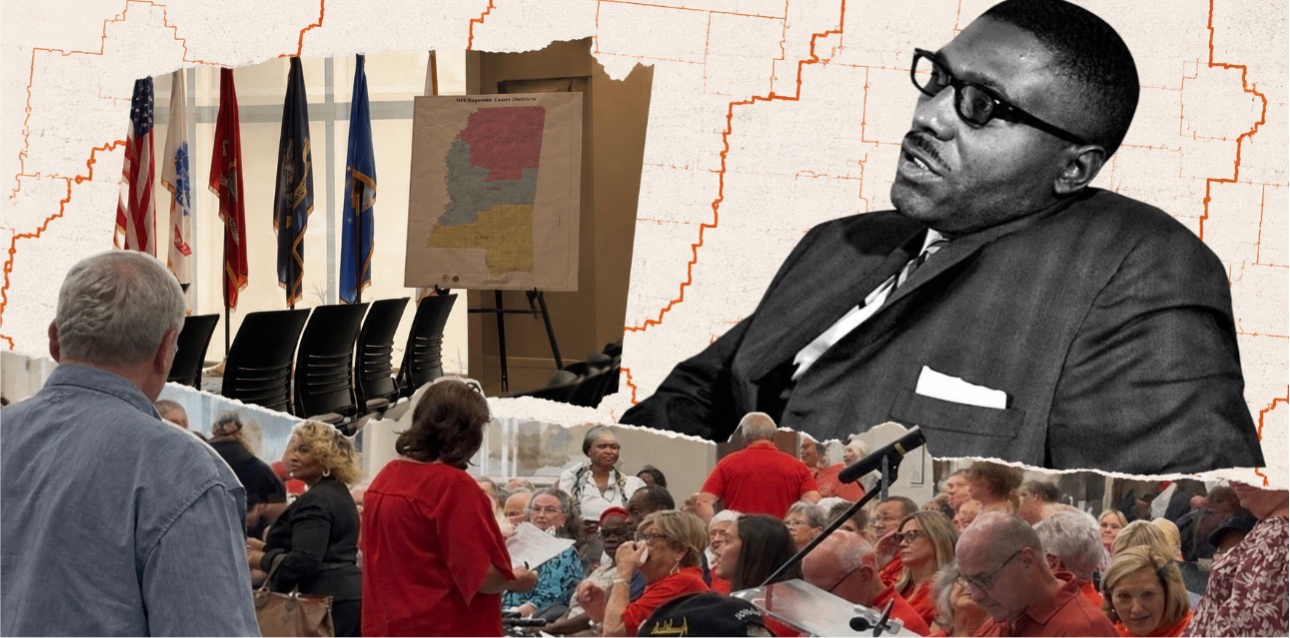
The joint legislative committee redrawing Mississippi’s districts is holding eight public hearings around the state, starting this summer and continuing into the fall, and at the first three the chair told each audience the same thing: the committee had come to listen and would not answer questions. Forty-five years ago, the legislature ran the same exercise, with the same number of hearings and much of the same types of testimony, and what moved the lines then is worth remembering now.
In the summer of 1981, following the 1980 census, a joint congressional redistricting committee held eight hearings across Mississippi. State Rep. Robert G. Clark Jr., then the state’s longest-serving Black legislator, reported afterward that the public had been strikingly consistent. “In most places we went, this is the one thing they suggested the committee look at,” Clark said, alluding to a district drawn to give Black voters a chance to elect a candidate of their choice. Clark sketched one himself, running from Wilkinson and Amite counties in southwest Mississippi and north along the river to Tunica County.
The committee rejected every plan that would have produced such a district. Its counsel, Jerris Leonard, told members that the Supreme Court had issued “no decision requiring this legislature to create a district for a minority group.” In August of that year, the committee approved what it called a least-change map, adjusting boundaries only enough to account for population shifts while preserving white majorities in all five congressional districts. The legislature ratified the districts with votes of 99 to 21 in the House and 42 to 9 in the Senate.
The sharpest exchange came at a hearing in Greenwood on Sept. 17, 1981. Clark appeared with David Jordan, Norman Smith, Willie Perkins and Owen Brooks. Jordan, then a science teacher and president of the Greenwood Voters League, accused the committee of having “wrongfully diluted thirty-six percent of Black votes in this state as though they didn’t even exist.” When Perkins challenged the committee’s chair, Rep. Tommy Campbell, directly, Campbell brought his gavel down hard enough to split it in two. Jordan won a seat on the Greenwood City Council four years later and went on to serve 32 years in the state Senate, retiring in June 2025 at age 92. He still lives in Greenwood. Sen. Justin Pope, who holds his old seat, sits on the committee running this year’s hearings.
What changed the map was federal enforcement. On March 30, 1982, the U.S. Justice Department rejected Mississippi’s congressional plan under Section 5 of the Voting Rights Act, finding that lines drawn horizontally across the Delta fractured Black communities and diluted their strength. Civil rights lawyers had already filed suit. Within two months a three-judge federal court threw out the state’s plan, adopted one that kept the Delta whole and ordered the 1982 elections held inside it. The new Second District ran from Tunica County south to Claiborne, following the river.
The hearings still mattered, though not in the way the committee described them. The record they produced, as well as who asked for what in which county and what the committee did with it, became evidence. Federal officials reviewing the plan under Section 5 could see that the public had asked for one thing and the legislature had done another.
The court-drawn district fell short at first. Frank Parker, the civil rights attorney who brought the case, called it a phantom majority-Black district. Its population was just under 54 percent Black, its voting-age population 48 percent, and whites remained a majority of its registered voters. Clark ran there in 1982 and lost. When the case returned to trial in December 1983, Tom Hofeller, the Republican redistricting expert testifying for the state, conceded that Black voters needed two more percentage points to balance the district. The state’s own witness had measured the disadvantage the state’s brief denied. On Dec. 21, 1983, a three-judge panel ordered the district redrawn, raising the Black share of the voting-age population to 52.8 percent and the total Black population to 57.8 percent. Clark ran again in 1984 and lost again. Mike Espy won the seat in 1986.
The pattern repeated following the 1990 census. The Justice Department rejected Mississippi’s maps, citing what it called clear evidence of racially discriminatory intent. The legislature deadlocked. White members dismissed the alternative as the Black Caucus plan, and a federal court ordered the state to run the 1991 elections under the old lines. Revised maps cleared federal review the following year. In special elections held under them in 1992, voters sent 33 Black members to the state House and 10 to the state Senate, roughly double the Black representation of two years earlier.
The most recent cycle is a close parallel. In 2021, the same standing joint committee, chaired by the same senator who chairs it now, Dean Kirby, held nine public hearings around the state between Aug. 5 and Aug. 23, 2021, and for the first time livestreamed them at Lt. Gov. Delbert Hosemann’s insistence. Hosemann later pointed to those hearings as evidence of an open process, saying the committee had met “in all regions of the state to hear from citizens about the map.” That December, as the committee approved new congressional lines, a coalition of groups filed a complaint with the state Ethics Commission alleging the committee had deliberated and made decisions outside properly noticed open meetings. The complaint said no public comment or citizen-drawn plan had been taken up in an open meeting.
The maps that emerged did not survive either. On May 7, 2025, a federal court ordered new state House and Senate lines after finding the 2022 maps diluted Black voting strength, which forced the special elections held that fall. The legislature had also failed to produce a congressional plan in the previous cycle, leaving a federal court to draw one on Dec. 30, 2011. Four cycles running, someone other than the Mississippi Legislature finished or fixed its maps.
Two things are different this time. The Supreme Court struck down the Voting Rights Act’s coverage formula in 2013, leaving Section 5 with no states to cover, so no Justice Department review now stands between a Mississippi map and an election. And on April 29, 2026, the court decided Louisiana v. Callais, holding 6 to 3 that Section 2 imposes liability only where the evidence supports a strong inference that a state drew its lines intentionally to give minority voters less opportunity because of race. Discriminatory effect—the standard that governed Mississippi’s cases for forty years—is no longer enough.
Speakers at all three hearings so far this year have argued that Callais requires nothing of Mississippi. Others have argued it requires everything. The committee has not said which reading it holds, because it has said almost nothing at all.
The new standard changes what a hearing record is worth, though not in the direction the committee may expect. What the 1981 record showed was “effect,” which was the question Section 5 asked. “Intent” is the question Section 2 now asks. A transcript establishing that residents of named counties asked for a particular district, that the committee heard them and that the map came back otherwise is the kind of evidence the Callais standard demands of anyone who sues.
Rep. Willie Bailey of Greenville, a veteran 34 years in the House but is not part of the redistricting committee [correct?], told the crowd at Delta State on Sept. 1, 2026, that the maps were already being drawn and that the testimony would go no further than the room. In 1981, that was true of the hearings but belied the record they left behind. Whether it is true of this one depends on who is writing it down and where they can take it.
Note on URLs: Some sources cited here are not available digitally, including quotes from newspaper archives and the Robert Clark papers at the Mississippi Department of Archives and History.
Image: Photo illustration featuring Robert Clark and attendees at recent hearings by Derrion Arrington
