


When Attorney General Lynn Fitch opened her campaign for governor by promising to accelerate the end of the state income tax, she said she would find the revenue to do so responsibly, but without specifying how.
Fitch likewise did not fully address the fact that lawmakers have already established a timeline for repealing the tax. The Mississippi Legislature in 2025 set the rate for doing so at 3 percent by 2030, with full elimination triggered by specific revenue-growth benchmarks that lawmakers project will be reached in about 13 years. Any change in the timeline would require legislative action.
Fitch acknowledged that lawmakers “would need to take action to move that timeline forward” yet stopped short of explaining how she would address the issue or replace a resulting loss of revenue. Despite her lack of details, Fitch thus inserted herself into a debate as old as the modern Mississippi budget.
The question centers on which taxpayers the state will lean on most heavily, which has shaped Mississippi’s finances for nearly a century. The income tax that Fitch wants to speed toward oblivion is one side of a balance the state has been adjusting since the Great Depression.
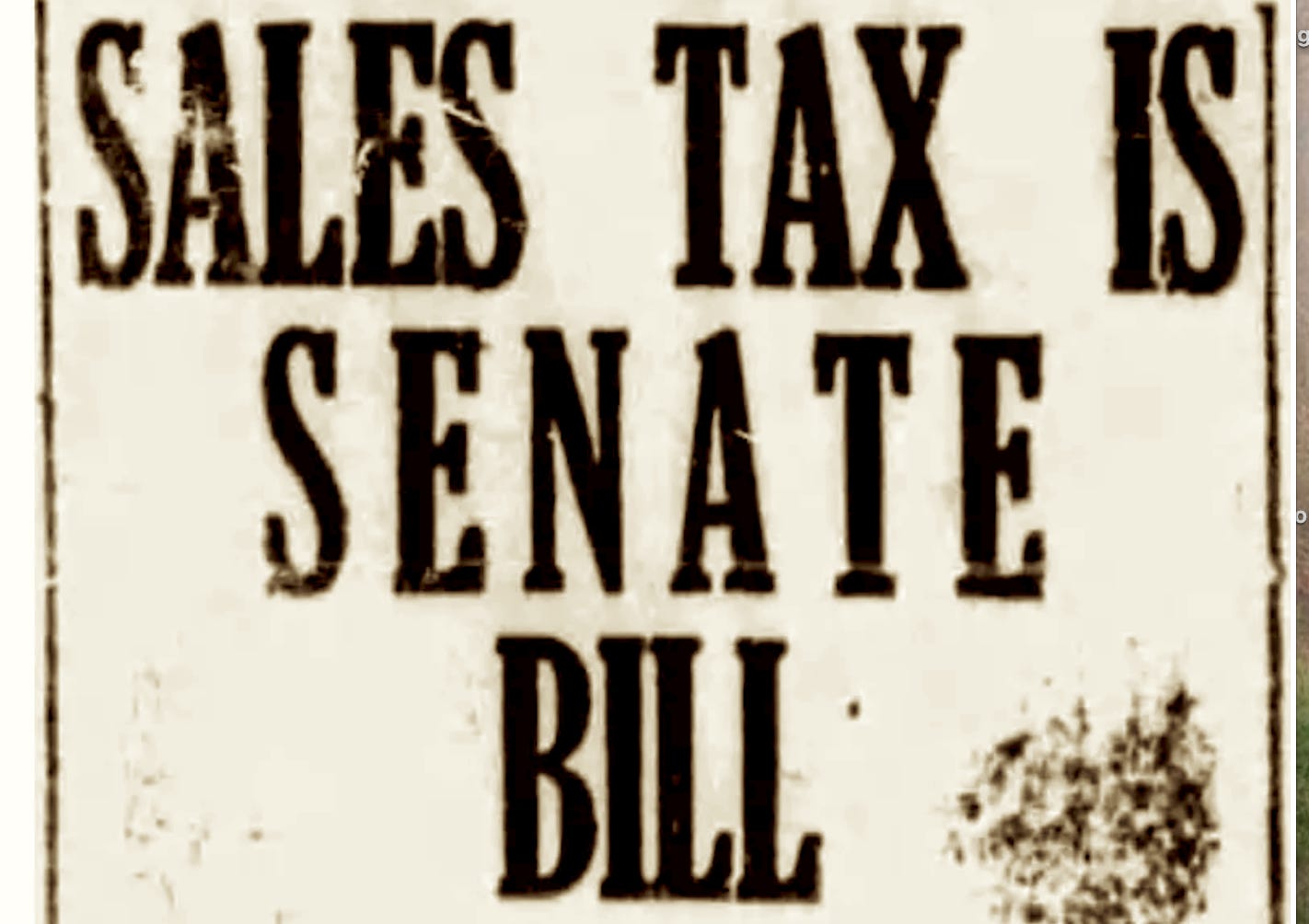
Mississippi built its revenue system during a time of financial crisis. In 1930, with property values collapsing and the state treasury near empty, the legislature enacted the nation’s first general sales tax, a 2 percent levy on retail sales, under Gov. Theodore Bilbo. Property-tax collections had been the backbone of state and local budgets but the Depression had knocked those back. By 1932, the state treasury took in barely 64 percent of the previous year’s property-tax receipts. The new sales tax enabled lawmakers to balance the budget. Twenty-three other states copied the system by the decade’s end.
The impacts of the tax were clear from the start. Summarizing the historical record, the Mississippi Encyclopedia describes the sales tax as a mixed blessing because of its regressive effect on low-income taxpayers. A tax on what people buy takes a larger share from those who spend most of what they earn, which in the poorest state means the majority of residents. Mississippi had chosen a revenue source that was stable for the state but fell heaviest, in proportion, on those least able to pay.
The income tax was the counterweight. Mississippi had adopted a personal income tax in 1912, making it among the first states to do so, and its burden fell more heavily on higher earners than the sales tax did. For most of the 20th century the two taxes coexisted; the sales tax was broad and regressive, the income tax narrower and tied to ability to pay. Together, they funded public schools, roads, hospitals and payrolls the state was responsible for.
Over time, the balance tilted toward the sales tax. Mississippi now draws more than 60 percent of its tax collections from sales and use taxes and a smaller share from the income tax. The state is also one of the few states to tax groceries at the full sales-tax rate, which increases the burden on low-income households. Successive rounds of income-tax cuts, beginning in earnest in 2016 and accelerating in 2022 and 2025, have steadily reduced the counterweight.
The 2025 law, the Build Up Mississippi Act, set the income tax on a path to zero. It lowers the rate in stages through 2030 and eliminates it entirely once state reserves and revenue growth hit the designated benchmarks. An analysis by the Institute on Taxation and Economic Policy, a Washington, D.C. think tank that favors progressive taxation, concluded that the repeal would reduce state revenue by nearly $2.7 billion per year at the time of full phase-in and deliver its largest benefits to the wealthiest households, an average cut of $41,420 for the top 1 percent against about $42 for the lowest-earning 20 percent. The University of Mississippi’s fiscal analysis projected the state would collect roughly $3 billion less in general-fund revenue by 2040 than it would have otherwise.
Eliminating the income tax removes the part of the system that asked more of higher earners, leaving the sales tax as the pillar of the budget. States without an income tax, which are the model Fitch cited, rely on sales and property taxes to make up the difference. Mississippi’s property-tax base is thin and its sales tax is already among the features that make its overall tax code most onerous for low-income residents.
This tension factors into Fitch’s pledge in her 2027 gubernatorial campaign.
The strain of lost revenue is already visible in the state budget. In the 2026 session, lawmakers funded the Division of Medicaid out of cash reserves and cited Medicaid’s costs in declining to give public school teachers a large pay raise. Mississippi ranks near the bottom nationally in teacher pay and in health outcomes, and it draws a larger share of its budget from federal dollars—45 percent—than all but three states (Alaska, Kentucky and West Virginia).
Supporters of eliminating the income tax say it will draw residents and businesses to the state and that growth will replace the lost revenue, as they contend it has done in states like Tennessee and Florida. For now, Mississippi is losing population, and opponents say the state is too poor to absorb the revenue loss and will be forced to cut services or further raise the sales tax (currently 7 percent).
The plan Fitch is campaigning on is fraught with historic and economic perils, and highlights a longstanding debate over which Mississippians should bear the brunt of funding state government.
Image: Headline from Jan. 10, 1930, Vicksburg Post (via Newspapers.com)

A fair Sales Tax plan would not tax unprepared food, usual household and personal items, flat 7% on just about everything else and luxury tax (15% ?) on recreational toys, boats, RVs and vehicles over a certain price. Shifting to property tax and zero state income tax will just raise the rent on low income citizens.
Republican's will only ever line their own pockets. The thought of her campaign for State Governor being a success is chilling - although if you vote for he don't say you weren't warned.