


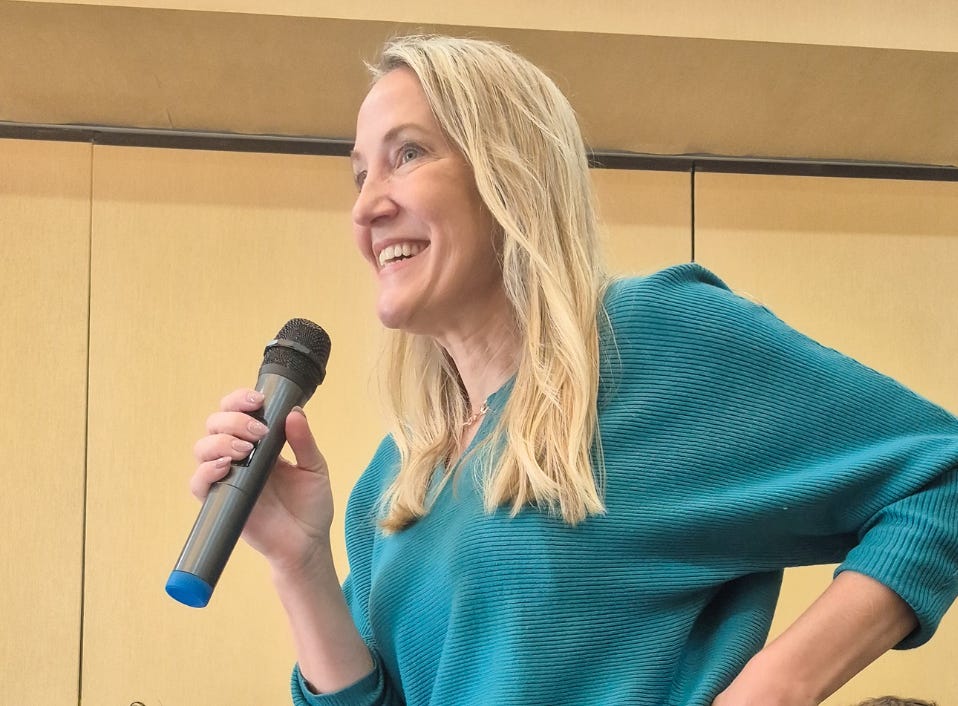
With five weeks until the March 10, 2026, Republican primary, Dr. Sarah Adlakha is waging an uphill campaign against U.S. Sen. Cindy Hyde-Smith, pitching herself as an outsider fighting Washington corruption while facing questions about her own ties to Mississippi.
Adlakha, a physician, real-estate developer and author who lives in Ocean Springs, announced her candidacy in September, becoming the most visible Republican challenger to incumbent Hyde-Smith since being appointed to the seat in 2018. A second Republican, Andrew Scott Smith of Florence, who lost a Republican primary in the 2nd Congressional District in 2024, is also on the ballot.
The challenge comes as Hyde-Smith received endorsements from President Donald Trump, Gov. Tate Reeves, Lt. Gov. Delbert Hosemann, Speaker Jason White and the state’s entire Republican congressional delegation. No Mississippi incumbent U.S. senator has lost a reelection bid since 1942.
An outsider campaign with unique complications
Adlakha, 53, has centered her campaign on transparency and campaign-finance reform, pledging to reject lobbyist donations and co-sponsor term limits legislation.
“I stepped into this race because I see that corruption, especially in our current U.S. senator, Cindy Hyde-Smith, and I really want to bring some transparency and accountability to Washington,” Adlakha said in a recent television interview.
Her campaign has highlighted Hyde-Smith’s acceptance of more than $300,000 from registered lobbyists and their family members during the past four election cycles. Adlakha has also pointed to the senator’s low rankings from the Center for Effective Lawmaking, a nonpartisan research collaboration between the University of Virginia and Vanderbilt University. The center ranked Hyde-Smith 46th out of 49 Republican senators on legislative effectiveness in its most recent assessment.
But Adlakha’s outsider message is complicated by her own background. A Chicago native who moved to Mississippi 13 years ago, she did not register to vote in the state until August 2024—a point the Hyde-Smith campaign has emphasized.
“We are happy our primary opponent recently moved to beautiful coastal Mississippi and decided to register to vote here in August 2024,” said Jake Monssen, Hyde-Smith’s campaign manager. “We welcome her participation in this election. As conservatives, we believe competition is good.”
Adlakha’s past social-media activity has also drawn scrutiny from critics. Following the 2020 election, she reportedly posted a message celebrating Vice President Kamala Harris’s historic election, writing that as “a mom of Indian daughters, this moment is pretty special.”
Business entanglements
Adlakha and her husband, cardiologist Dr. Sati Adlakha, are developing Legacy Park, a $48 million mixed-use project in Gautier that includes an outpatient cardiac surgery center. The development has been the subject of a prolonged dispute with the Jackson County Board of Supervisors and Singing River Health System, the county-owned hospital network, over a certificate-of-need and public-financing requests.
The Mississippi Supreme Court recently upheld the certificate of need, but the Jackson County Board of Supervisors denied the developers’ request for approximately $1 million in tax increment financing. The dispute generated heated exchanges on social media, with some posts calling the board “corrupt” and “mafia.”
The local politics surrounding the development led Adlakha to back the incumbent independent Gautier mayor over a Republican challenger in last year’s municipal elections—an unusual choice for a candidate seeking Republican primary votes.
Hyde-Smith’s position
Hyde-Smith enters the primary with significant advantages beyond her endorsements. Federal Election Commission filings show the incumbent with nearly $2.5 million in cash on hand compared with Adlakha’s approximately $122,000. Adlakha seeded her campaign with a $201,000 personal loan.
The senator has locked up support from the state’s Republican establishment, with endorsements from dozens of state legislators in addition to the statewide and federal officeholders.
Trump’s endorsement, announced in March 2025, called Hyde-Smith “100% MAGA” and praised her work on border security and agriculture.
Yet Hyde-Smith’s electoral history suggests she has vulnerabilities. In 2018, her special election victory over Democrat Mike Espy—53.6 percent to 46.4 percent—was the closest non-primary U.S. senate race in modern Mississippi history. In 2020, she won reelection by 10 points but underperformed Trump’s Mississippi margin by approximately six percentage points.
In December 2025, Hyde-Smith voted to table an amendment that would have banned senators and their spouses from trading stocks, blocking a debate on the ethics measure without a vote on its merits. The senator’s 2018 campaign was marred by controversy after a video surfaced in which she said of a supporter, “If he invited me to a public hanging, I’d be in the front row.” The comment drew national criticism and prompted several corporate donors to request refunds.
The general election field
On the Democratic side, three candidates are competing in the March 10 primary: Lowndes County District Attorney Scott Colom, military veteran Albert Littell, and Priscilla Williams Till, a cousin of Emmett Till. Ty Pinkins, who lost a senate bid in 2024 as a Democrat and sought the secretary of state position in 2023, is running as an independent and will appear on the November ballot regardless of the primary outcomes.
National Democrats have identified the Mississippi seat as a potential target, though the state’s Republican lean—Trump carried it by 17 points in 2024—makes any Democratic path to victory narrow.
If no candidate receives a majority in the March 10 Republican primary, a runoff will be held on April 7, 2026. The general election is Nov. 3, 2026.
Image: Sarah Adlakha (via her campaign Facebook page)
