


When Gov. Tate Reeves appoints two justices to the Mississippi Supreme Court--the date for which has not been announced, he will technically influence the makeup of the state’s ultimate judicial body only until November 2026.
Yet history shows that such appointments have staying power beyond their initial installments.
The opening for the appointments follows U.S. Senate confirmation of President Donald Trump’s nominations of existing state Supreme Court justices Robert Chamberlin and James Maxwell to federal judgeships. The Senate Judiciary Committee advanced both nominations on Nov. 20, 2025, after they had been blocked for weeks by North Carolina Sen. Thom Tillis in a dispute over federal recognition of the Lumbee tribe in his state. Tillis told reporters he was using Mississippi’s judicial appointments as leverage in negotiations with Mississippi Sen. Roger Wicker. Tillis sought to include language granting federal tribal recognition to the Lumbee in the defense authorization bill that Wicker, as chairman of the Senate Armed Services Committee, oversees. The committee also advanced Trump’s picks for U.S. attorney positions in Mississippi: Scott Leary for the Northern District and Baxter Kruger for the Southern District.
The appointments will create two vacancies in state Supreme Court District 3, which covers 33 northern Mississippi counties including DeSoto, Lafayette, Lee and Lowndes. District 3 voters elect three of the court’s nine justices. Both Chamberlin and Maxwell were reelected to eight-year terms in November 2024, meaning their seats extend to 2032. Under state law, Reeves’ appointees will serve until special elections in November 2026, with the winners serving the remainder of the original terms through 2032.
Mississippi’s special election process requires candidates to run without party designation, though the state’s nonpartisan judicial elections have become increasingly influenced by partisan politics and outside spending. Campaign finance records show major political donors openly supporting candidates aligned with their party preferences, despite laws intended to keep judicial races nonpartisan.
The vacancies continue a pattern in which most Mississippi Supreme Court justices first reach the bench through gubernatorial appointment rather than by defeating an incumbent. As of January 2025, four current justices were initially appointed by a Republican governor and five were initially selected through nonpartisan election.
Mississippi changed its vacancy rules in 2002. Previously, gubernatorial appointees had to run for election much sooner to keep their seats regardless of how much time remained in the term. Under current law, if more than four years remain in a term, the appointee serves until the next general election occurring at least nine months after the vacancy. If four years or less remain, the appointee serves the remainder of the term without facing a special election.
Mississippi has debated how to select judges since statehood. The state became the first in the nation to implement popular election of judges in 1832, when its constitution was amended to allow voters rather than the legislature to choose judges. As historian Jed Handelsman Shugerman notes in his book The People’s Courts: Pursuing Judicial Independence in America, the 1832 constitutional convention prompted fierce debate among three cohorts: wealthier Mississippians who favored gubernatorial appointment; so-called “half hogs” who wanted some judges elected and others appointed; and “whole hogs” who demanded all judges be elected. The whole hogs prevailed.
The state briefly returned to gubernatorial appointment during Reconstruction—the 1869 constitution provided for the governor to appoint judges with Senate confirmation—but popular election resumed in the 1890 constitution. From 1916 to 1980, all Supreme Court elections were effectively decided in Democratic Party primaries, as Mississippi functioned as a one-party Democratic state and Republicans rarely challenged in general elections.
The legislature eliminated judicial primaries and made judicial elections nonpartisan in 1994. The change came amid court modernization efforts and in response to civil rights litigation demanding redistricting of judicial districts to increase Black representation on the bench. In the 1970s, Mississippi’s judicial system ranked last nationally on measures of legal professionalism.
The 1994 Nonpartisan Judicial Election Act prohibited political parties from raising funds for judicial candidates, directly contributing to their campaigns, or publicly endorsing candidates. Campaign finance limits cap individual and PAC contributions at $5,000 for Supreme Court races. Despite these restrictions, recent Supreme Court elections have drawn significant partisan involvement, with the state Republican Party openly endorsing conservative candidates.
Chamberlin served as a state senator for five years before becoming a circuit judge, then joined the Supreme Court in 2016. Maxwell worked as a federal prosecutor before Governor Haley Barbour appointed him to the Court of Appeals in 2009, then Governor Phil Bryant elevated him to the Supreme Court in 2016. Both earned their undergraduate and law degrees from the University of Mississippi.
Chamberlin and Maxwell testified at a Senate confirmation hearing in September. Once confirmed, they will fill federal district court vacancies in northern Mississippi. Chamberlin will replace Judge Michael Mills, who took senior status in 2021. Maxwell will replace Judge Sharion Aycock, who took senior status earlier this year.
Reeves has appointed prosecutors to fill several judicial vacancies during his tenure as governor. Joel Smith moved from district attorney to the Court of Appeals in 2021. Matt Sullivan left his position as district attorney for a circuit judgeship in 2021. Thomas Michael Reed, whom Reeves appointed as a circuit judge in 2025, had worked as a prosecutor. John Weddle and John Emfinger, both appointed by Reeves to the Court of Appeals, had prosecutorial backgrounds.
The Mississippi Supreme Court handles death penalty cases, constitutional challenges, election contests, and questions of first impression. The court has nine justices elected from three judicial districts to eight-year terms in nonpartisan elections.
The recent Supreme Court elections saw conservative challenger Jenifer Branning defeat incumbent Justice Jim Kitchens in a November runoff. Kitchens is among the rare Mississippi Supreme Court justices who won his seat by defeating an incumbent rather than being appointed first. Most justices reach the court through gubernatorial appointment to fill vacancies, then win election to full terms.
The Senate Committee on Indian Affairs held a hearing earlier this month on the Lumbee Fairness Act, separate legislation pushed by Tillis and other North Carolina lawmakers. Trump has endorsed federal recognition of the Lumbee.
Mississippi’s two U.S. senators, Roger Wicker and Cindy Hyde-Smith, supported the four nominees and spoke on their behalf at confirmation hearings. Neither serves on the Judiciary Committee.
“I am pleased that President Trump’s nominations to the U.S. District Court for the Northern District of Mississippi and for the state’s U.S. Attorneys have passed the Senate Judiciary Committee,” Wicker said in a statement. “Justices Chamberlin and Maxwell and Messrs Kruger and Leary are highly qualified individuals. They will uphold the law, defend the Constitution, and serve Mississippi well.”
The federal vacancies in northern Mississippi have remained unfilled for years. President Joe Biden nominated District Attorney Scott Colom of Columbus to fill Mills’ seat and Colom completed all required background checks, but his nomination did not advance in the Republican-controlled Senate.
The two Supreme Court appointments give Reeves the opportunity to shape the composition of Mississippi’s highest court, likely beyond the remaining term.
Given Reeves’s pattern of appointing prosecutors to judicial positions throughout his tenure, legal observers expect his Supreme Court selections to follow a similar profile. The appointments come as the court’s conservative majority has solidified following Branning’s defeat of Kitchens, and as Mississippi continues to grapple with questions about judicial selection, the influence of partisan politics in nonpartisan elections, and the balance between gubernatorial appointment power and voter choice in determining who sits on the state’s highest court.
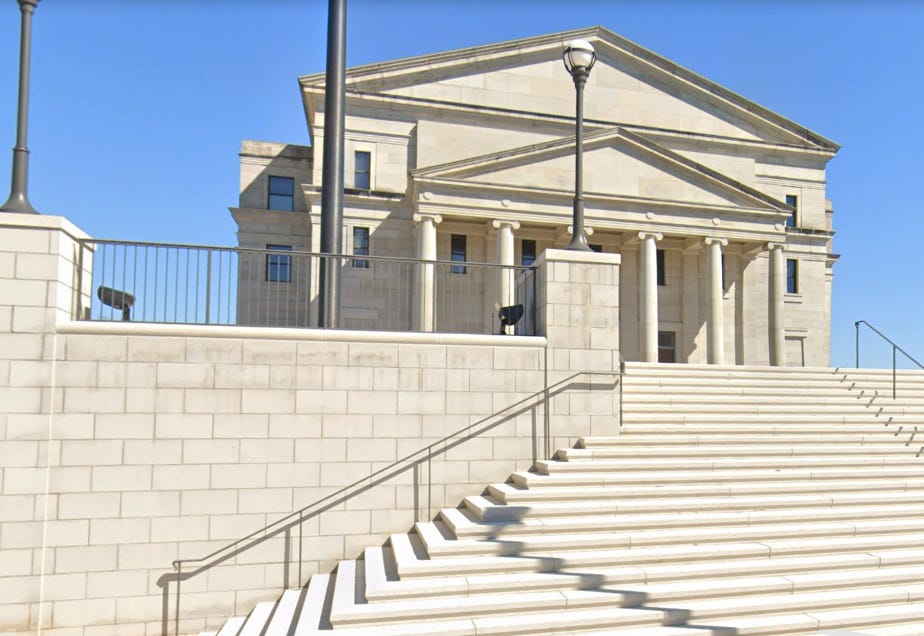
Image: Carroll Gartin Justice Building, November 2025 (via Google Earth)
