


After he was deported to Ecuador in late 2024, Michael Alcivar Carpio left a brief, inconspicuous account of his experience inside the Adams County Correctional Center outside Natchez, Mississippi: a one-star Google review.
“It was the hardest experience of my life,” Carpio wrote in the review, which The Mississippi Independent confirmed as authentic after contacting him at his home in La Troncal, Ecuador, a small city about 160 miles south of the nation’s capital, Quito. “I was just a 24-year-old guy who had never committed any crime, and to be taken there from one day to the next is something painful and hard to explain.”
For a time, Carpio’s account remained online as a small but unusually direct record of confinement inside one of the nation’s largest immigrant detention centers. Then, one day without warning, his review disappeared as Google deleted and disabled ratings and reviews for immigrant detention facilities across the United States.
The deleted reviews were what researchers say had become a rare public-facing archive of life inside immigrant detention facilities, part of a federally led crackdown on illegal and legal immigration that has included a continual wave of violent and deadly encounters between Immigration and Customs Enforcement officers and the rapid erosion of judicial, executive and democratic norms.
“The decision by Google to limit access to past archives of ICE reviews reveals that democratic, and by extension carceral, accountability deepens our understanding of the company,” Muira McCammon, an assistant professor at Tulane University in New Orleans, wrote in her latest research article about the phenomenon of the missing reviews. “It also suggests that Google, through practices of content moderation, is helping to co-produce ICE’s institutional reputation, especially by making certain reviews entirely inaccessible.”
McCammon’s paper, titled “You can call it whatever you like, but this is a prison: A sociotechnical audit of US Immigration and Customs Enforcement Google reviews and ratings,” examines more than 1,600 reviews across 26 ICE facilities. Reviewers described confinement conditions, staff treatment, communication breakdowns between detainees and families, alleged human rights abuses and efforts to resist ICE through public criticism.
McCammon began collecting any reviews she could find in August 2025. She has spent years studying how U.S. carceral institutions, from Guantánamo Bay to ICE detention facilities, are shaped by online platforms—and what is lost when governments and technology companies delete, deactivate or erase records.
The paper, published on June 23, 2026, in New Media & Society, argues that Google reviews of ICE detention facilities are more than consumer feedback. The deleted accounts were fragments of important testimony, glimpses into the shadowy immigrant detention system by detainees, former detainees, relatives and advocates describing the conditions inside.
For Carpio, the story behind his vanished review began before he ended up in the Adams County Correctional Center.
Carpio told The Mississippi Independent that he had been living in Ecuador when he decided to apply for asylum at the U.S. border. He aimed to see his mother, who was living alone somewhere in the country and was desperate to see her children. Carpio was not trying to disappear into the nation’s interior without a trace, he said. “I didn’t hide,” he said. “I didn’t cross the illegal way, hidden. I turned myself in to U.S. immigration.”
That decision led first to a Border Patrol detention facility—what some migrants call a hielera, or icebox—where he said he was held for eight days and only fed bread and water. After that, he said, he was transferred to Mississippi with shackles on his wrists, feet and waist. “As if I were the worst criminal in the world,” he said. “As if I had committed a triple homicide, or as if I were a psychopath.”
Carpio, now 26, said he has no criminal record and has never hurt anyone or been in any trouble in his life.
Record of anguish
McCammon’s research identified 14 additional reviews of the Adams County Correctional Center, with names withheld out of caution (Carpio gave his consent to be identified). One person said the guards were racist, while another said the detention facilities represented the worst of the U.S. government. Another review was written as a prayer, calling on God to hear detainees’ anguish and set them free from their unjust imprisonment.
Those reviews are all now deleted.
Google has said its policies restrict reviews of places where contributions may be “unhelpful, harmful, or off topic,” including places people do not choose to visit or where they do not have direct experience. Its examples include police stations and prisons, but, oddly, also schools, oceans and seas.
But McCammon said Google’s rationale was unusual.
“That phrase ‘unhelpful’ stands out to me,” she said in an interview with The Mississippi Independent after her paper was published. “It’s a reminder as well that Google is not necessarily prioritizing democratic accountability, which can be unhelpful for market imperatives and profit incentives.”
Google users can still find and leave reviews for many institutions where firsthand experience is difficult to verify and where comments are often irrelevant, abusive or political. Reviews remain visible for Mississippi colleges, government offices, businesses, fire departments, shelters, museums and other public-facing institutions. Some are written by people who do not appear to have entered the places they review. Others include insults, partisan complaints or remarks about events that the reviewers clearly did not witness.
Yet nearly all reviews for immigrant detention facilities have been stripped of comments describing what happened inside.
McCammon’s study asks whether Google’s justification is sufficient when the comments being suppressed concern prisons, jails and detention centers—many of them operated by private prison companies, paid for by taxpayers, and largely hidden from public view.
“The governmentality employed by Google shows how search engines can—on an ad hoc basis—limit attempts to publish carceral counternarratives and call attention to the cruelty of carceral infrastructure,” McCammon wrote in the article.
The issue is especially acute in the sphere of immigration enforcement, where public access is already limited.
Unlike most criminal court records, immigration detention and immigration court proceedings are difficult for the public to access. Families may struggle to locate relatives. Transfers, releases and deportations can happen with little notice. Filings are not readily available online. Some immigration courts restrict public and media access. Many immigrants currently locked up have never been offered due process or even a bond hearing.
Advocates say the result is a system in which people can be arrested, moved through detention centers and deported with little meaningful public visibility or legal oversight.
Google did not respond to The Mississippi Independent’s questions about whether the removal or disabling of reviews for immigrant detention facilities was connected to requests from ICE, the Department of Homeland Security or other government entities. Neither DHS nor ICE responded to similar questions.
McCammon’s research does not prove that Google and ICE jointly decided to erase specific reviews. But it raises a key question: How much control over these public narratives came from Google alone and how much came through contact with ICE, detention facilities or the federal government?
Google publishes transparency reports showing government requests to remove content from its products, but those reports generally do not specify the exact content at issue or identify the specific agency involved.
Google’s report includes 357 requests to remove reviews beginning in July 2021. Many were court-ordered, while others were issued by government officials citing reasons such as privacy, security or defamation. It is unclear whether any of those requests involved reviews of immigrant detention facilities.
McCammon also found signs in the reviews that some ICE facility listings involved institutional participation, including contact information that was confirmed by phone. It is worth noting that Google holds hundreds of millions of dollars in U.S. government contracts.
End of a dream
For people like Carpio, McCammon’s research is entirely academic. Communicating from his home in Ecuador, Carpio said his life has changed because of his experience in immigration detention. Before leaving, he had a stable job working at a public drinking water company. Now, he is earning about $300 a month or less. “I’m not living, I’m surviving, and with tremendous trauma from the deportation,” he said.
After leaving ICE’s Adams County facility, Carpio was moved to the Winn Correctional Center in Louisiana. “Winn is a horrible, horrible place,” he said. “As if it were a medieval prison. I was in those nightmares for one month and three weeks until they deported me and ended my dream.”
Carpio never did get to see his mother.
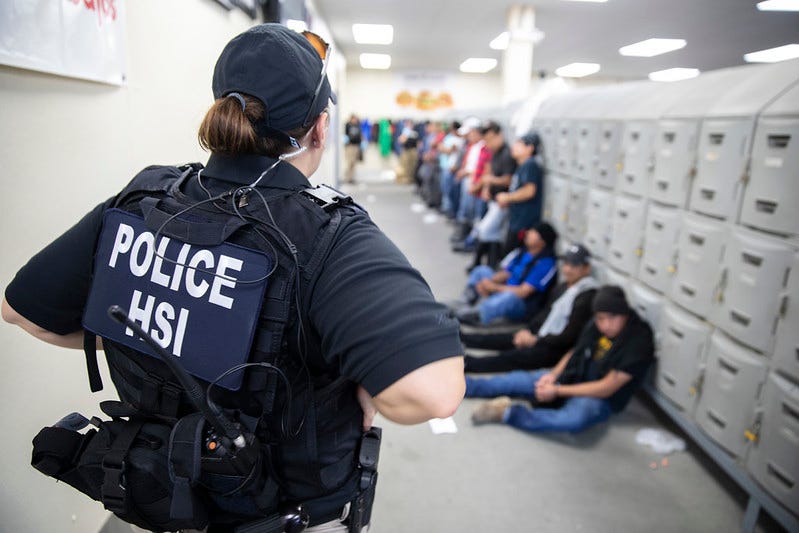
Image: Immigration and Customs Enforcement Homeland Security Investigations worksite enforcement operation in Canton, Mississippi (via Department of Homeland Security)

Thank you for telling this story! It's pretty great to get this reporting from the Indy since I've limited my news sources!