


The Fifth Circuit Court threw out an order blocking Mississippi’s anti-DEI law on Oct. 22, 2026, and directed the chief judge of the Southern District of Mississippi to give the case to a different judge.
House Bill 1193 can be enforced again while the case proceeds.
The law, which took effect in 2025, bars public schools and universities from requiring diversity training, from maintaining offices or courses that promote a list of concepts the act defines, and from giving racial or sexual preference in hiring or contracting. A school that is adjudicated to have violated it twice, with the first violation uncorrected after 30 days, loses state funds until it complies. Teachers and professors are regulated. Students are not.
A group of teachers, professors, students, parents and organizations sued in June 2025. Senior U.S. District Judge Henry Wingate blocked the law.
The appeals court found that Wingate’s order was built in part on things that do not exist.
The temporary restraining order Wingate signed on July 20, 2025, named 11 plaintiffs who had never been parties to the case. Among them were Mississippi Votes, the Black Student Union at Jackson State University, the Mississippi Library Association and the Mississippi chapters of Delta Sigma Theta. The order also named two defendants that no on had sued, the commissioner of higher education and the state superintendent of education. It said three universities had already cancelled DEI programming because of the law, with no evidence in the record. It quoted House Bill 1193 as banning “race or sex stereotyping,” “race or sex scapegoating,” “critical race theory” and “institutional bias,” none of which appear in the act. And it cited declarations from four people who, the panel wrote, do not appear in the record “and may not even exist.”
The state pointed out the errors two days later. The court took the order off the docket, replaced it with a corrected version backdated to July 20, and refused to put the original back, calling the problems clerical.
After U.S. Sen. Chuck Grassley accused the court of using artificial intelligence, Wingate acknowledged the errors and said a law clerk had used A.I. in drafting.
At oral argument in New Orleans, the panel found the corrected order still cited a Fourth Circuit case called Cousins v. School Board of City of Norfolk. No such case exists.
Judge Jerry E. Smith wrote the opinion. “The proceedings in the district court were a botch job, to say the least,” the opinion says. “This district judge carelessly exercised his Article III power by issuing sloppy edicts based on falsehoods and fabrications.” The district court, Smith wrote, “or perhaps, being charitable, its AI agent,” ignored and manipulated the governing law “apparently to satisfy a policy agenda.”
A footnote says the panel was “grateful, and, indeed, lucky” that the state had filed a copy of the original order as an exhibit, because Wingate had kept it from public view.
Reassignment on remand is a power the court calls extraordinary and rarely invoked. The panel applied both of the tests the circuit uses and found each one was met.
Wingate has been on the federal bench in Mississippi for 41 years. He was born in Jackson in 1947, went to Grinnell College and Yale Law School, and served as the Navy’s only African American judge advocate from 1973 to 1975. He was a special assistant attorney general for the state, then an assistant district attorney in Hinds and Yazoo counties, then an assistant U.S. attorney. U.S. Sen. Thad Cochran recommended him and President Ronald Reagan nominated him. He was sworn in on Oct. 19, 1985, the first African American appointed to a life-tenured federal judgeship in Mississippi and one of eight Black judges among roughly 300 whom Reagan named. He led Operation Pretense, the corruption investigation that reached 56 county supervisors. He became chief judge in 2003.
Fifth Circuit Judge Catharina Haynes concurred in the last paragraph of the opinion, alone. She wrote that on remand it is important to make sure teachers are not limited or forbidden from teaching students not to discriminate as Title VII sets out.
The plaintiffs can ask the full Fifth Circuit to rehear the case. The panel also spent 10 pages telling the next district judge how to read House Bill 1193 and what law to apply.
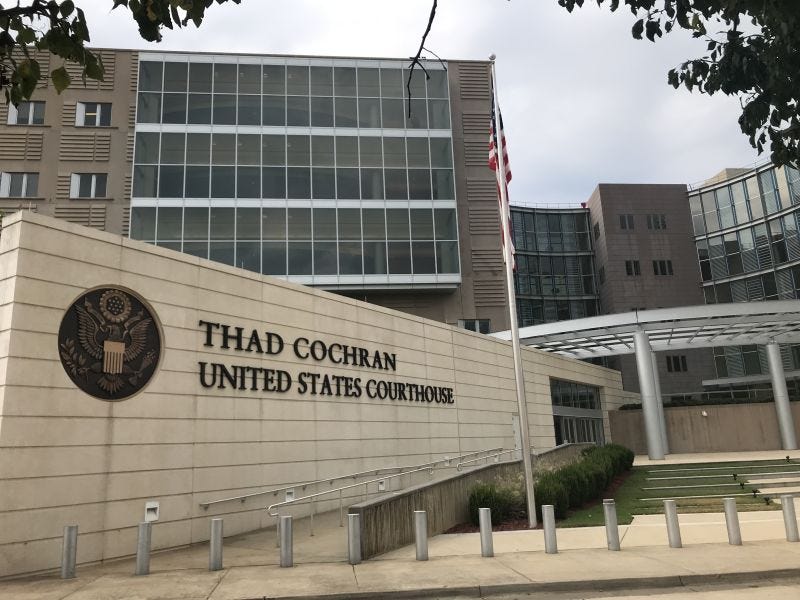
Image: U.S. District Court building, Southern District of Mississippi (via the court’s LinkedIn page)
