


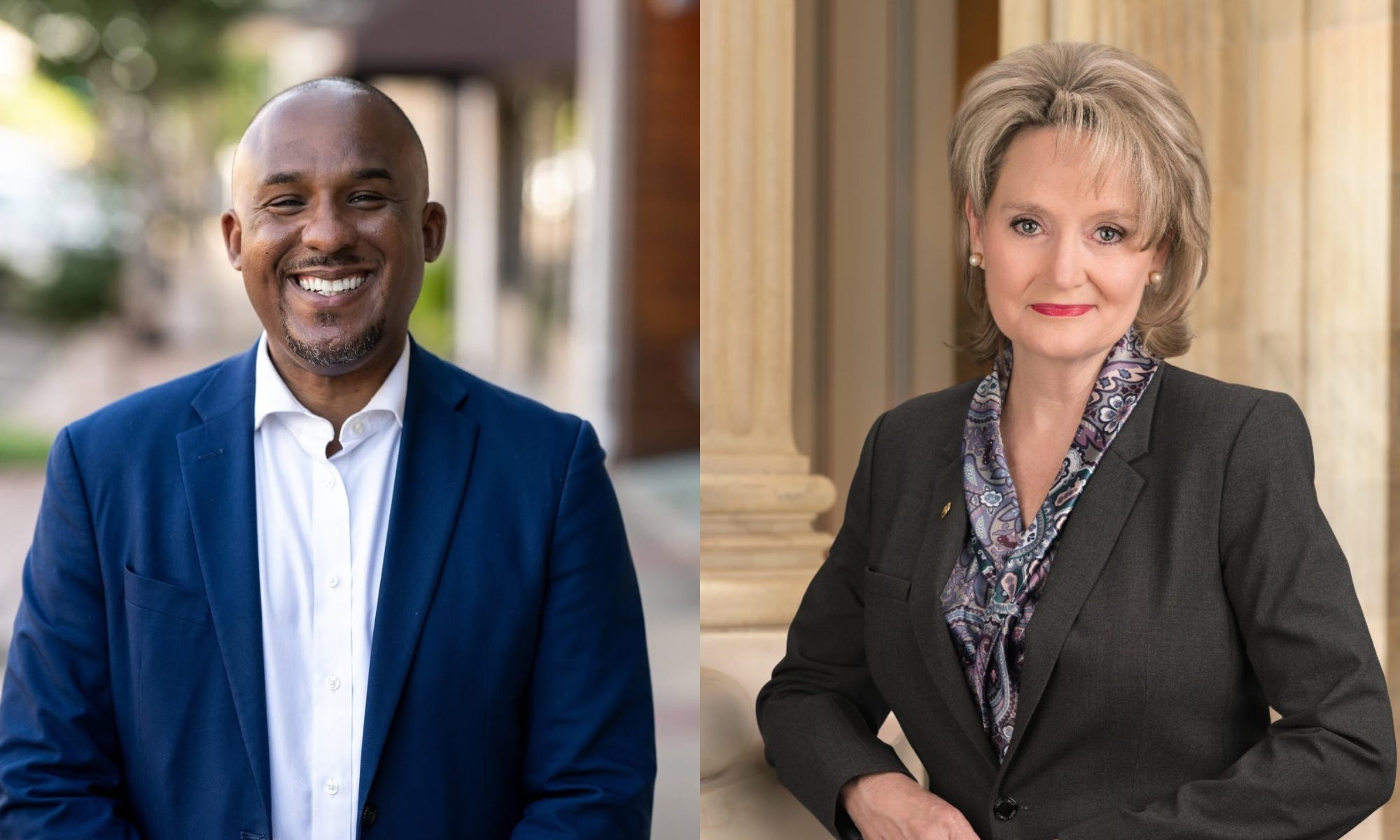
Every major election handicapper rates Mississippi’s 2026 U.S. Senate race solidly or safely Republican. Cook Political Report, Sabato’s Crystal Ball, Inside Elections and RealClearPolitics all place it out of reach for Democrats.
Mississippi has not elected a Democrat to the Senate since 1982, and President Donald Trump carried the state by 23 points in 2024.
Yet Scott Colom, the Democratic district attorney challenging incumbent Sen. Cindy Hyde-Smith, argues that the picture the ratings describe is already out of date.
Colom points to a poll the Southern Policy Law Center Action Fund and Impact Research released in April, which The Mississippi Independent reported at the time. It found Hyde-Smith with an unfavorable rating of 55 percent and put Colom within three points of her in a head-to-head matchup, narrowing a gap that the same pollster had measured at 13 points in June 2025.
The Colom campaign notes that Democratic turnout in the March 10, 2026, Senate primary reached roughly 150,000 votes, up from about 82,000 in the 2024 Democratic Senate primary, an increase of more than 80 percent. The campaign argues that the race now belongs in the same conversation as Republican-held seats in North Carolina and Texas that national Democrats are working to flip.
“Standing on that stage in Jackson with Congressman Thompson and Derrick Johnson, looking out at more than five thousand Mississippians who showed up in the middle of the day to stand up for voting rights, I didn’t see a state that has given up,” Colom said in a statement to The Mississippi Independent, referring to the May 20 voting-rights rally that drew thousands to the Jackson Convention Center. “On the contrary, I saw a state that knows exactly what’s at stake.”
The question put to Colom was whether Republican map-drawing and voting restrictions have made it impossible for Democrats to win in Mississippi regardless of how voters feel about the party in power. He answered by reframing the premise. “As a prosecutor, the rule of law matters to me deeply,” he said. “The Voting Rights Act was won here in Mississippi, and right now it’s being unwound here in Mississippi, and that is not by accident. When politicians redraw the maps to carve up parts of our state like the Delta or the Jackson metro, they’re making plain that they no longer want the voters to pick them, they want to pick their voters.”
Colom tied the redistricting fight to material conditions in the state. The politicians redrawing the maps, he said, “don’t want to have to answer to a farmer in the Delta who can’t sell his soybeans, or a mother who can’t afford her medication, or a rural hospital preparing to go dark.”
In background comments, Colom campaign officials said the redistricting contest exists because politicians in both parties have stopped trusting voters to decide elections, and argued that the Supreme Court’s narrowing of Section 2 of the Voting Rights Act, the push to redraw the majority-Black Delta and Jackson metro, and the absence of early voting in Mississippi are aimed at the communities the Voting Rights Act was written to protect. The campaign officials said the backlash to those moves is already measurable in Hyde-Smith’s favorability decline and the primary turnout surge, and that in a low-turnout state, motivated voters carry more weight, not less.
Hyde-Smith holds advantages that the poll does not erase. She had raised about $4.7 million by the time of the primary, against $1.2 million for Colom, which was a record for a Mississippi Democrat but less than a third of the incumbent’s total. She has Trump’s endorsement and a seat on the Appropriations Committee. The Cook Political Report, in rating the race solidly Republican, has cited the state’s underlying partisanship as the reason a favorability problem has not translated into a tossup. The campaign says it outraised Hyde-Smith in the final quarter of last year and has kept pace since, which it argues is not the fundraising pattern of a safe incumbent.
Yet, in a nod to the potential for an upset, the super PAC American Bridge 21st Century announced on June 9 that it will spend $2 million on the Senate race, among 20 Senate and House races being targeted. Bradley Beychock, the organization’s cofounder, said in a news release: “Many Americans are angry that President Trump has betrayed them, and we want them to share their stories. Working class voters are fed up with the cost, chaos, and corruption. Our investment aims to seize this opportunity in traditionally Republican territory.”
Hyde-Smith’s campaign did not respond to the same list of questions submitted by The Mississippi Independent.
Colom closed his comments with the answer he said he would give a discouraged voter: “To the Mississippian who’s been told their vote can’t change anything, I say: that’s exactly what they want you to believe. Mississippians have beaten longer odds than a three-point race against an unpopular incumbent. We’ve been here before, and we know what to do.”
In addition to Colom and Hyde-Smith, independent candidate Ty Pinkins will appear on the ballot for the Senate seat in November.
Image: Scott Colom, Cindy Hyde-Smith (via Creative Commons)
