


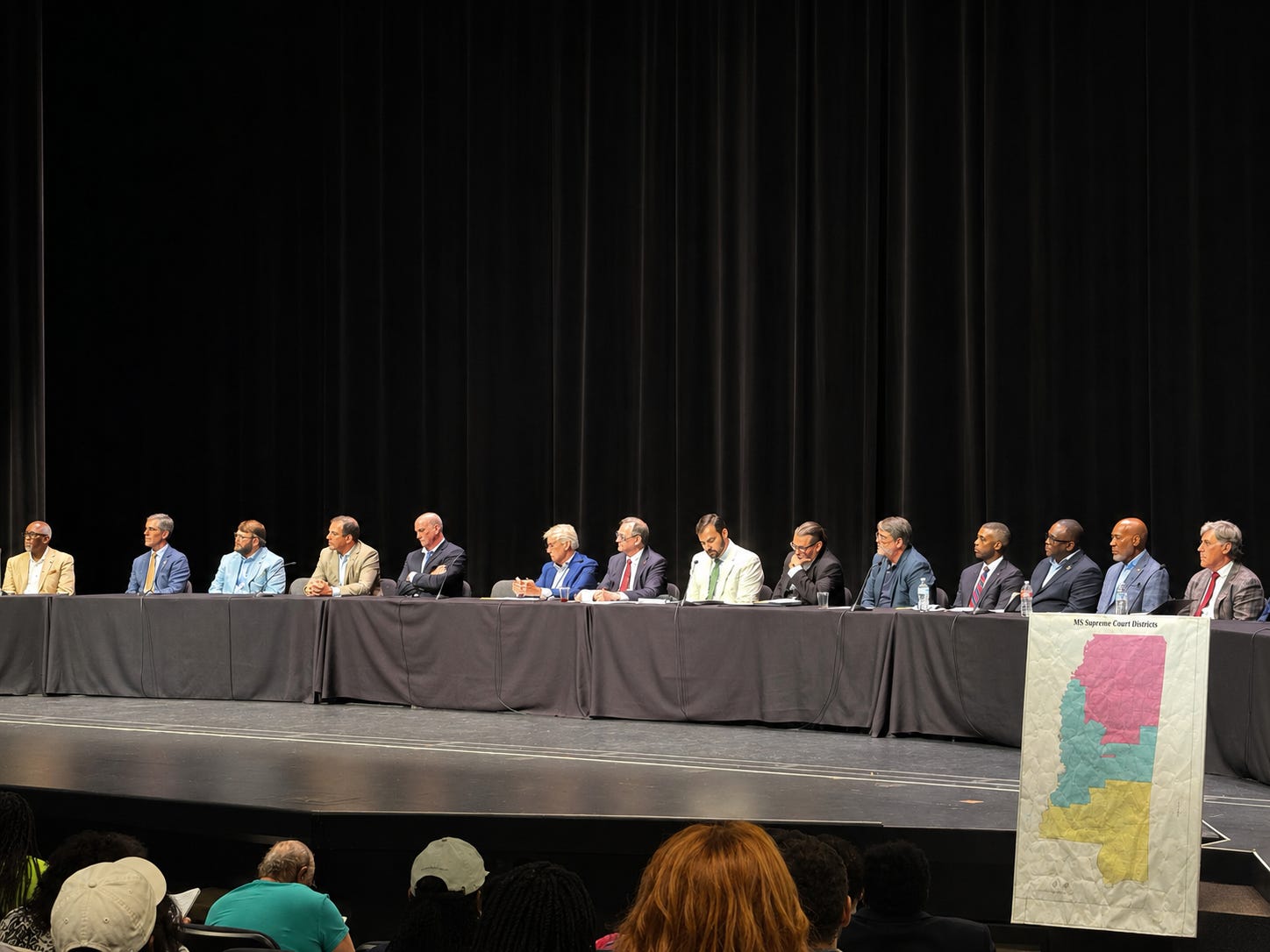
CLEVELAND, Miss.—The state’s redistricting committee brought its third public hearing to the Mississippi Delta on Tuesday, and the first legislator to reach the microphone following the chairman’s opening told the crowd not to expect much from it.
“Nothing you’re going to say tonight is going to end up as a part of any plan. Nothing,” Rep. Willie Bailey, a Democrat from Greenville who has served 34 years in the Mississippi House, told several hundred people at Delta State University’s Bologna Performing Arts Center in Cleveland. “They’re already being drawn. They probably already know who they’re going to cut out.” Bailey added, “They’re up here to listen to you, but that’s as far as they’re going. It ain’t going no farther than this room tonight.”
Speaker after speaker followed Bailey, in a region that makes up the heart of the state’s only majority-Black congressional district, to urge the Joint Committee on Reapportionment and Redistricting to leave the current district maps alone. The hearing at Delta State was the third of eight the committee is holding across the state before lawmakers take up new legislative, congressional and judicial maps in the wake of the U.S. Supreme Court’s decision this year in Louisiana v. Callais.
State Sen. Dean Kirby of Pearl, the chair, opened by saying the committee was there “to listen, not to talk,” and would take no questions.
The Delta’s legislators came out in numbers to take the microphone. Rep. John Hines of Greenville contradicted Kirby’s assurance that the hearings had nothing to do with local government.
“This redistricting starting here in the legislature will affect your municipalities, your counties, your school districts, your levee boards, everything,” Hines said. “Once they start up top, it works its way down.”
Rep. Timaka James-Jones of Belzoni, who served for more than 20 years as Humphreys County circuit clerk before her election to the legislature, told the committee that none of its members had ever run an election and warned that redrawing lines ahead of the January 2027 qualifying period would leave clerks and election commissioners without time to fix the state’s election management system. “You’re going to have mass confusion throughout this entire state,” she said, before closing with an observation about the panel in front of her. “Evidently we have not any ladies on this committee.”
Several speakers argued that the committee was asking the wrong questions. Mike Carr, a Cleveland trial lawyer on the Bolivar County Democratic executive committee, said he had read the Callais opinion and that it does not require Mississippi to take action. “There is no Supreme Court mandate that’s making us do this,” he said. “We’re not getting sued by anybody saying our lines are wrong.” He said the party in power already holds the governor’s office, both chambers and three of four congressional seats.
“What else do you want?” Carr asked.
Jaribu Hill, founder of the Mississippi Workers’ Center for Human Rights and an attorney, made the same point and said the maneuvers around Callais “only serve to reinforce what in fact so many people gave their lives to overturn.”
The most specific request came from Mary Tyes-Williams, the mayor of Itta Bena, who said that if the committee proceeds with redrawing districts, it should keep the Delta and Hinds County together in the Second Congressional District along with the state’s three public historically Black universities, Jackson State, Alcorn State and Mississippi Valley State. “We are not pawns to be played with,” she said.
Nathan Duff proposed a district built around all 18 counties of the Mississippi Delta National Heritage Area, DeSoto County included, running south along the river to Wilkinson County.
Melvin Young, a cartographer from Tunica County who has drawn maps for local governments, said the last redistricting cost the state $1,721,169 and asked that the committee not “resurrect outdated maps simply because they may produce a desired political result.”
Marvin Jones, the Humphreys County circuit clerk, said, “The people don’t want it. The law doesn’t require it. So, go back to the state and tell whoever sent y’all that you don’t even want to finish this process because it’s not needed.”
Effie Burt, 72, who said she had returned to Mississippi after 40 years away and claimed to find the racism she left still in place. She ended her remarks by singing a verse of “We Shall Overcome” to the committee.
Troy Brown Sr. thanked President Donald Trump for the large turnout. “He does not realize that he has unleashed the Kraken,” Brown said, pointing to the young people in the hall, referencing a legendary sea monster more recently evoked in internet memes to represent a sprawling, unsubstantiated set of voter fraud claims during the last U.S. presidential election.
A smaller group asked the committee to redraw the maps. Miller Green, 19, of the Second District, said districts should treat voters as individuals and that the current congressional map should change.
Susan Spiller of Greenwood, president of the LeFlore County Republican Women, asked for maps to be drawn on “traditional race-neutral criteria,” a phrase that recurred among Republican speakers at last week’s hearing in DeSoto County. Her husband, Rob Spiller, argued that the current lines give incumbents in all four congressional districts no reason to court voters of the other race, and that redrawing them would force candidates to “consider both white and black input.”
The night’s most candid account of the politics of redistricting came from a supporter of the effort. Shuwaski Young, a Republican who said he owns a home behind the Delta State campus, reported having spoken with legislators across the state and said the reason the legislature did not act before this year’s midterm primaries was fear of the result. “The hesitation was that, hey, if we’ve moved too fast, we actually might get more Democrat districts in the state,” Young said. He argued that lines drawn under the Supreme Court’s standard would give the state “full representation of what our state actually should look like.”
Willie Simmons, the Central District transportation commissioner and a Cleveland Democrat who served 26 years in the state Senate alongside many of the committee’s members, spoke last. He recalled Black and white lawmakers working together after Hurricane Katrina and through the COVID-19 recovery, and asked the committee to keep a legislature and executive branch “where we can sit across the table and work with each other.” He said he would put his faith in his former colleagues to produce a plan “with diversity that allows us to represent the 40 percent of Blacks, approximately, in the state of Mississippi.”
The committee took no questions and adjourned after roughly two hours. Five hearings remain, the next on Sept. 8 in Natchez, followed by Meridian, Hattiesburg, Gulfport and Jackson, where the series ends on Sept. 24. Written comments can be sent to the committee’s counsel, Ted Booth, at ted.booth@peer.ms.gov.
Image: Committee members and staff at the Cleveland hearing (credit Derrion Arrington)
