


The astonishing closeness of the U.S. Senate election between Democrat Scott Colom and incumbent Republican Cindy Hyde-Smith is making national news even amid the intensive coverage of the electoral earthquake that will give Democrats control of the U.S. House and Senate.
There are multiple reasons for the attention, but chief among them is that the election is so close, illustrating, perhaps as much as any race ever has, that every vote matters.
Colom’s lead also provides an exclamation point to the larger Democratic juggernaut, given that he is a Black Democrat in a state with a charged racial history that has for decades voted decidedly Republican in statewide elections and which voted for President Donald Trump by more than 20 points in 2024.
Among national outlets, the Wall Street Journal reported on Colom’s “wafer-thin lead” over Hyde-Smith by just 43 votes as of 9:00 a.m. Eastern Time, Nov. 4, with more than 945,000 (about 95 percent) of the ballots counted. The narrow margin means the vote might come down to provisional ballots, which could take days to review, the Journal noted.
In Mississippi, counties must certify their votes by Nov. 13 and the Secretary of State’s office declares the final results on Dec. 3. Under Mississippi law, a recount can be ordered only by court order, the Journal reported.
Mississippi, in fact, has never passed a recount law. No Democrat has won a Senate race in the state since John Stennis in 1982. Affidavit ballots in the current Senate race are still under review, and mail ballots postmarked by Election Day can arrive for five more business days—a window that the U.S. Supreme Court upheld in June in Watson v. Republican National Committee.
If the final margin stays this close, the losing candidate will find that Mississippi offers fewer ways to potentially challenge the outcome than almost any other state. Mississippi has no recount law at all, automatic or requested. Election law scholar Derek Muller noted overnight that the state’s election code also contains no procedure for contesting a general election for Congress. For Mississippians, that means the question of who represents them in the U.S. Senate could be settled in Washington, D.C. by senators from other states.
Mississippi’s election code lays out three kinds of contests: party primaries, county offices and legislative seats. A losing candidate in a party primary can contest the result under Section 23-15-923, first before the party’s executive committee and then in court. Chris McDaniel took that road after losing the 2014 Republican Senate runoff to Thad Cochran. A special circuit judge threw out the case, and the Mississippi Supreme Court affirmed that in October 2014, holding that a 1959 decision, Kellum v. Johnson, gave candidates 20 days to file (McDaniel waited more than twice that long). Section 23-15-951 lets a voter or candidate contest an election for an office within a county by petition in circuit court.
Two routes are still open in the relevant U.S. Senate race. The first is litigation over specific ballots. A campaign can go to court under state or federal law over decisions to count or to reject particular affidavit or mailed ballots. A ruling there can change the vote totals.
The second is in the U.S. Senate. Article I, Section 5 of the U.S. Constitution makes each chamber of Congress the judge of the elections, returns and qualifications of its members. In Roudebush v. Hartke in 1972, the U.S. Supreme Court allowed Indiana to run a recount in a disputed Senate race, holding that the Senate kept the power to make its own judgment after a state recount. Since then, most states have written recount and contest procedures for federal races.
The Senate’s own record shows how long that kind of judgment can take. In New Hampshire in 1974, Republican Louis Wyman and Democrat John Durkin traded the lead through two recounts, and the state ballot commission finally put Wyman ahead by two votes. Durkin petitioned the Senate in December 1974. The Rules Committee deadlocked, the full Senate deadlocked, and after seven months the Senate declared the seat vacant. New Hampshire held a new election in September 1975 and Durkin won it by more than 27,000 votes.
A vacancy in a Mississippi’s U.S. Senate seat would put the seat in the hands of the governor until a new election. Gov. Phil Bryant used that appointment power in 2018 to send Hyde-Smith to the Senate after Cochran resigned.
The state has watched a legislative body decide its elections twice in living memory.
On Jan. 4, 1965, the Mississippi Freedom Democratic Party challenged the seating of the state’s five white congressmen. Fannie Lou Hamer, Annie Devine and Victoria Gray argued that the men had been elected in districts where Black Mississippians were kept from voting. The House Elections Subcommittee took depositions across the state for months. On Sept. 17, 1965, the full House voted 228 to 143 to dismiss the challenge and keep the delegation in its seats.
The second case ran through the Mississippi Senate, and Hyde-Smith was part of it. In December 2003, Richard White contested the certified election of Dwayne Thomas in Hinds County’s Senate District 29. The Senate created a special committee of five senators, including Hyde-Smith, who was then a state senator from Brookhaven, to hear the case. After three days of hearings in January 2004, the committee found that errors in the November election made it impossible to determine what District 29’s voters had chosen. The full Senate refused to seat Thomas and ordered Hinds County to hold a new election between the two men on Feb. 10, 2004.
That same session, a state House bill to let party executive committees recount ballots in primary contests died in committee. Recount bills have died the same way since. In January, Rep. Timmy Ladner, a Republican, filed House Bill 1026, which would have required a recount, by a different method from the original count, in any race decided by 250 votes or 1 percent of the total, whichever was greater. It died in the House Apportionment and Elections Committee on Feb. 3. Under that bill, a 43-vote margin in a race with nearly a million ballots would have triggered a recount automatically.
County election commissions will spend the coming days reviewing affidavit ballots, and each county will then certify its results to the Secretary of State. Any lawsuit over individual ballots would come during that canvass. If the margin holds in the dozens, the question would go to the Senate that convenes on Jan. 3, 2027.
Mississippi’s lawmakers have had opportunities to write their own answer since at least 2004, during the same session that their own Senate threw out a certified result in Hinds County, and they have let each bill die in committee. Perhaps no one in power expected to need one. Republicans have won every U.S. Senate race in the state since Trent Lott took an open seat in 1988, most of them by double digits.
If this count holds, the U.S. Senate will decide who holds the seat.
But a lot could change in the meantime, as a result of the counting of affidavit and mail-in ballots.
A version of this article appeared in Derrion Arrington’s Substack “America is Mississippi.”
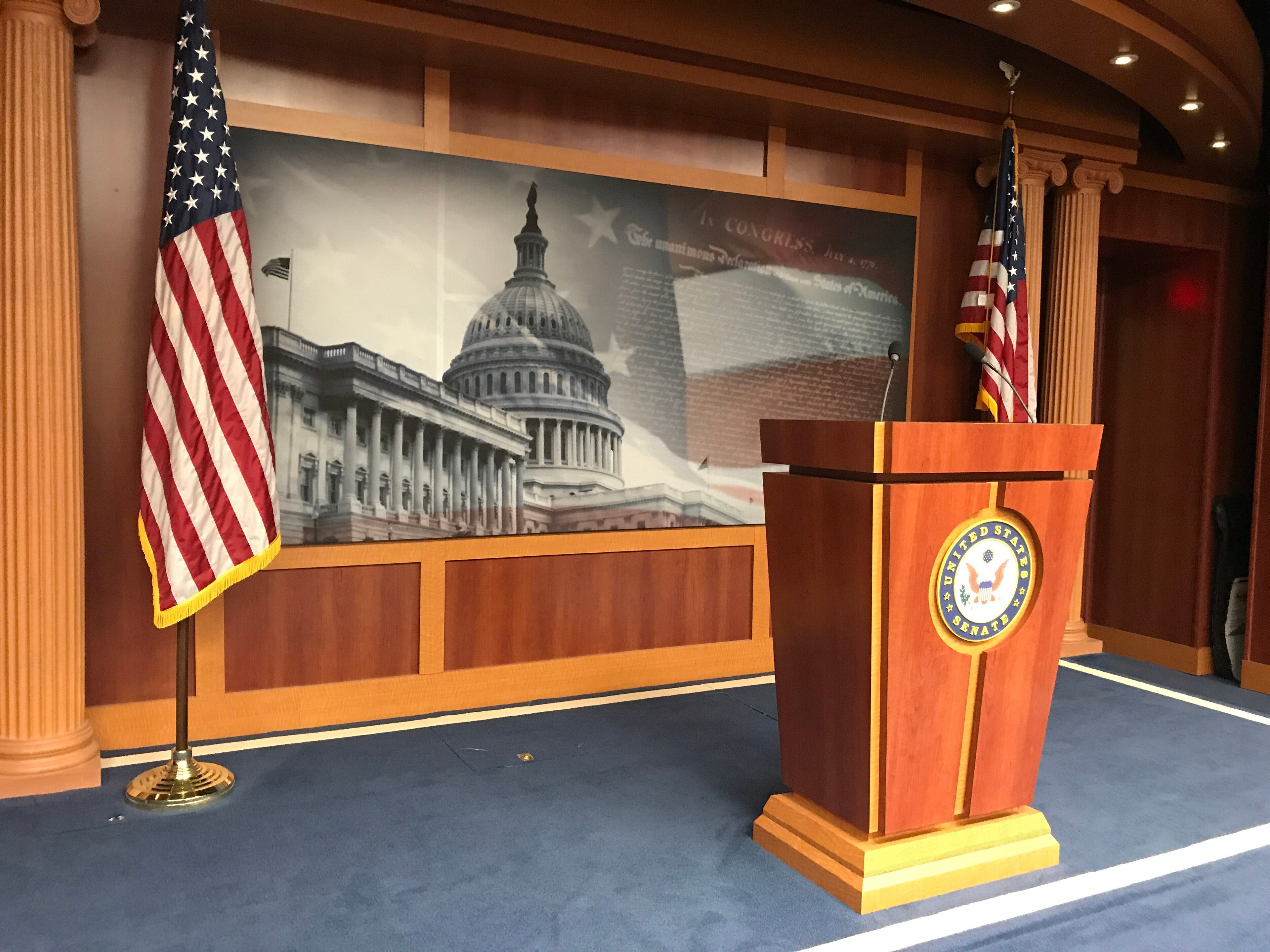
Image: U.S. Senate podium (via Wikimedia)
