


BILOXI—Sonya Williams-Barnes told the Joint Legislative Committee on Reapportionment and Redistricting on Tuesday night that she did not learn about House District 119 from a map.
“I knew them by name,” Williams-Barnes said of the district’s constituents. “They called when their sons and daughters were sick inside our state prisons and could not get medical care. They called when conditions in one prison unit was so deplorable that they were unfit for an animal.”
Williams-Barnes, who represented District 119 from 2012 until she resigned in May 2022 to take a job with the Southern Poverty Law Center, and who ran for mayor of Gulfport last year, closed with four words that other speakers returned to throughout the hearing: “Leave our maps alone.”
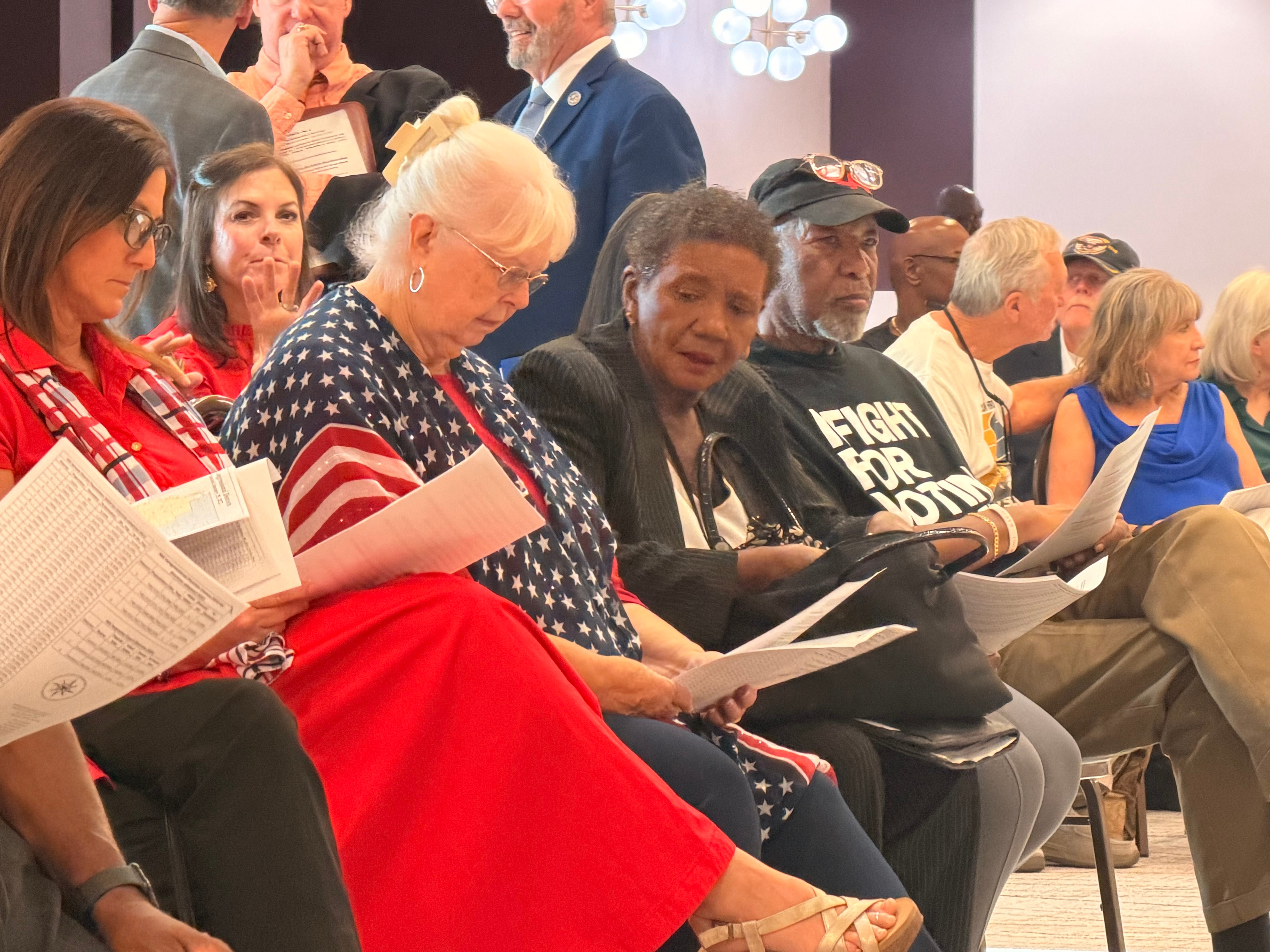
Fifty-five people signed up to speak at Mississippi Gulf Coast Community College, the seventh stop on the committee’s eight-hearing tour. State Sen. Dean Kirby, the committee’s chair, told the room it was the largest sign-up list of the tour.
“This is not the largest crowd we’ve had, but it’s the most people that want to make comments of any place we’ve been, and we’ve been all over the state,” Kirby said.
Comments were held to two minutes. Ryan Morgan, an attorney with the legislature’s PEER committee, rang a bell at 90 seconds and twice more when time ran out.
The first speaker was state Rep. Jeffrey Hulum III, who holds the District 119 seat Williams-Barnes left and won the Democratic nomination in March for the Fourth Congressional District seat held by Republican U.S. Rep. Mike Ezell.
“I’m totally against any midterm redistricting,” Hulum said. “The Callais decision did not say we have to redistrict in the state of Mississippi.” He said the legislature should instead restore the ballot initiative and let voters decide.
Most speakers took that position. A larger number than at the committee’s earlier stops asked the legislature to redraw the maps, framing the request around the U.S. Supreme Court’s decision in Louisiana v. Callais and a standard they described as race-neutral.
Rob Maness opened his remarks with a disclaimer. “Since I am a retired military officer, I’ll just do a disclaimer right now. Nothing I say represents the Department of War or any other government entity that I may be working with.”
Maness retired from the Air Force as a colonel in 2011 after more than 30 years and ran unsuccessfully for the U.S. Senate in Louisiana before moving to Mississippi. He sits on the Harrison County and Gulfport Republican executive committees. The Washington Post reported this year that he holds an undisclosed role in the office of the undersecretary of defense for personnel and readiness. He told the committee that Callais “returns authority to the states” and that Mississippi’s Second Congressional District “has been among the poorest in America for years.”
“Those outcomes did not happen by accident,” Maness said. “They have persisted under the current lines.” He said he supported redrawing congressional districts “to respect communities of interest” and opposed “maps drawn that protect incumbents or to serve an outside agenda.”
Mark Brody spoke later in the evening and identified himself as with the Conservative Coalition of Mississippi and the same Harrison County Republican Executive Committee.
Brody’s remarks tracked Maness’s closely. He said the Second District “has remained one of the poorest in the entire country for years” and that “these outcomes have persisted under the current district lines.” He said the maps should not “protect any particular incumbent or outside agenda,” that Callais “returns one more authority to the states,” and that the committee should “take bold action,” a phrase Maness also used.
Brody cited a median household income of $47,495 for the Second District and a poverty rate of 23.6 percent. He said the Conservative Coalition was circulating a redistricting pledge for legislators and candidates to sign. The Second District, which covers many of Mississippi’s westernmost counties, does not encompass the Gulf Coast.
Vivian Daly, an educator born in Biloxi, described a specific redistricting method. “Draw four districts of equal population that are contiguous, reasonably compact, respect county and precinct lines, and keep communities of interest together with no racial data in the room.”
Most speakers rejected that framing directly.
Monica Thomas-Hurst said the phrase troubled her. “I’ve heard a few say that they don’t see color. Now that statement alone troubles me, because what that means is you don’t see me and many others in this room.”
Noelle Nolan Ryder, a resident of Ocean Springs, identified herself as a fifth-generation Mississippian from Natchez and the granddaughter of William A. Geiger, whom she described as an active member of the Silver Dollar Group of the Ku Klux Klan during the civil rights movement.
“I say that so this panel understands I know what white supremacy in Mississippi is and how it operates,” Ryder said. She referenced the state’s 1890 constitution and its poll taxes and literacy tests, and noted that lawmakers were now redrawing districts in Forrest County, “named after the founder of the KKK.”
Betty Sparkman of Pass Christian told the committee her ancestors enslaved people and that eight of her forefathers fought for the Confederacy.
“They fought to preserve a system that denied Black Americans their freedom, their rights, and their voice,” Sparkman said. “And here we are, 156 years later, discussing a new version of that same oppression.”
Alan Jenkins, who said he has been a Baptist pastor for 26 years, gave the committee numbers from the same period. At least 142,000 Black men were registered to vote in Mississippi before the 1890 constitution, he said, and only 8,615 remained on the rolls by 1892.
“Do you think those men suddenly decided they didn’t want to vote anymore?” Jenkins said.
Cost came up repeatedly. Warren Conway told the committee a special session would run $100,000 per day. Chantrelle Graham-White, a Gulfport voter, said the money should go to problems that residents had actually raised.
Several speakers asked for something the committee has not provided at any stop. Angela Ellis of Gulfport asked for the court order she said would justify the redistricting effort.
“Show us the order. Show us the specific legal requirement that says Mississippi must redraw these districts right now,” Ellis said. She asked the committee to release proposed maps with racial voting-age population data attached, and to say how many majority-Black districts exist now and how many would exist afterward.
Mohamed Hardy, a Harrison County voter and a leader in what he called the largest Islamic community on the Coast, said his members were watching the precedent.
“Are we going to draw the lines based on religion?” Hardy said. “If it bothers my constituents, it probably bothers yours as well.”
Carrissa Corbett, the Ward 6 councilwoman in Gulfport, said the committee could not speak for her constituents without having been among them. “You cannot speak for us, especially without listening to us.”
John Whitfield, pastor of Morning Star Baptist Church in Gulfport, said he believed the effort originated outside the state. “You can move the line, but you should not, and you will not, silence the voices.”
The last speaker was Mitch Ellerby of Moss Point, a Vietnam veteran who represented Jackson County’s District 110 in the state House and told the committee he served from 1984 to 1992.
“I’ve done redistricting,” Ellerby said. “Listen to your heartbeat, listen to your mind, most of all, listen to the voters, because we know best, too, but you have the last say.”
The committee took no questions and adjourned. One hearing remains, at the New Capitol in Jackson on Oct. 1, 2026. Written comments may be sent to the committee’s counsel, Ted Booth, at ted.booth@peer.ms.gov.
Image: Participants in the Biloxi hearing (credit Derrion Arrington)
