


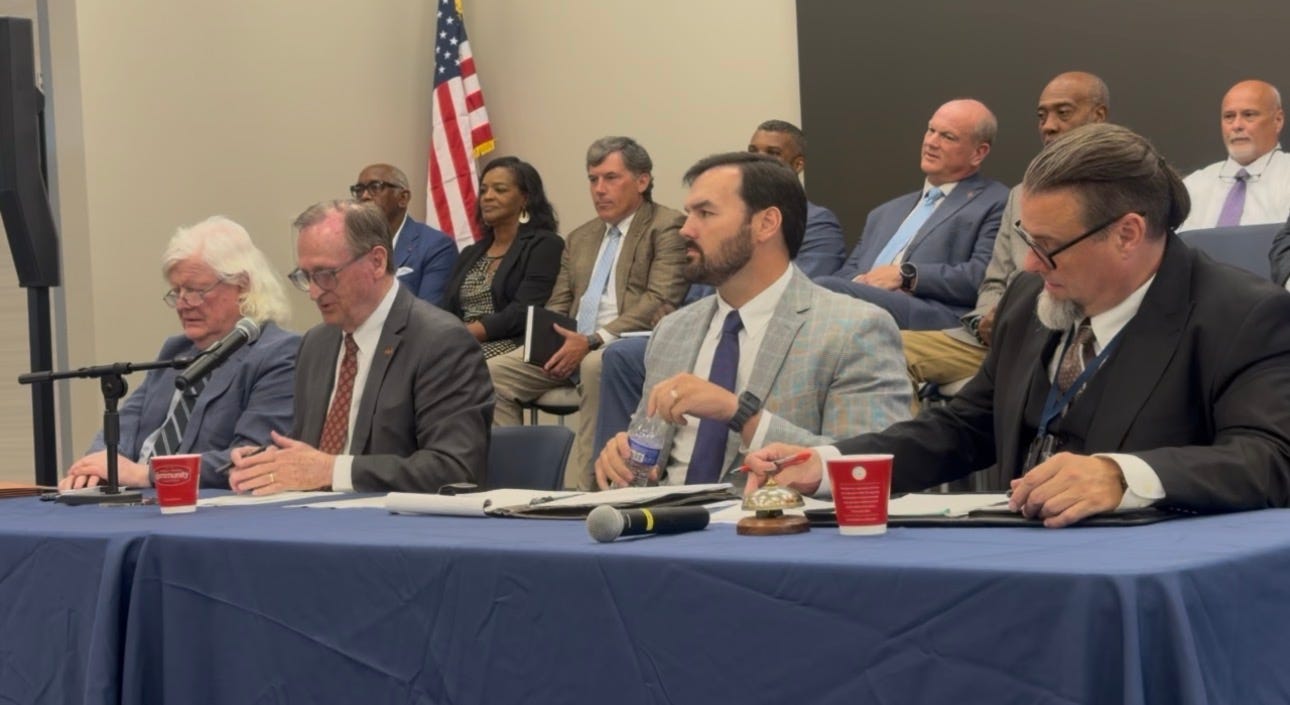
Note: A previous version incorrectly identified the location of the meeting as the main campus of Northwest Mississippi Community College in Senatobia. It took place at the college’s DeSoto Campus Ranger Conference Center in Southaven.
SOUTHAVEN, Miss.—Speaker after speaker at a redistricting hearing here urged the legislature to redraw Mississippi’s voting maps, to take race out of the process, and to dismantle the majority-Black districts that a federal court and lawmakers have upheld.
It was the second of eight hearings the state will hold through late September, and the crowd at Northwest Mississippi Community College’s DeSoto Center in Southaven asked for close to the opposite of what speakers in Tupelo had sought nine days earlier, when nearly everyone present told the committee to leave the maps alone.
The hearing was held on Aug. 27, 2026, in the suburbs south of Memphis, in one of the fastest-growing and whitest parts of the state, the latter of which was reflected by the makeup of the crowd. Speaker after speaker identified themselves as an officer of a Republican club, an executive committee member or a party volunteer, and many delivered a nearly identical message, that the state should redraw its districts using what they called traditional race-neutral criteria. Several read the same phrases and legal citations, and one speaker announced that a group would soon circulate a congressional redistricting pledge for legislators and candidates to sign.
Lee Caldwell, a DeSoto County supervisor, put the argument in personal terms. She said she had asked her constituents whether her race mattered to them, and “my constituents said I just want you to come serve me.” Mark Gardner, another DeSoto County supervisor, recalled a lawsuit in which a federal judge sided with the county against a demand to draw a majority-minority district. “I learned a song in Sunday school, red and yellow, black and white, they are precious in his sight,” he said. “That is how I view my life and that’s how I conduct myself.”
The through-line was the U.S. Supreme Court’s decision this year in Louisiana v. Callais, which raised the bar for using race in drawing districts. Speakers cited it repeatedly, along with Justice Clarence Thomas’s concurrence, to argue that Mississippi is now required to draw maps without regard to race. Several read passages from Thomas describing race-based districting as repugnant to a colorblind Constitution. The Voting Rights Act, one speaker argued, protects equal opportunity to participate and does not guarantee proportional representation by race.
Much of the anger in the room was local and specific, aimed at the majority-Black judicial subdistrict a federal judge upheld this month. Under that arrangement, voters inside a nine-precinct subdistrict around Horn Lake and Southaven help elect two judges that most of the county cannot. State Rep. Kimberly Remack, a Republican from DeSoto County, said the system “creates two different classes of voters in the same county,” and asked the committee to repeal the subdistrict provisions in two 2025 bills and require that judicial elections be held countywide. Katie Ligon, a Republican officer who was among the plaintiffs in the failed lawsuit against the subdistrict, told the committee that most DeSoto County voters would head to the polls in November unable to vote for two of the judges who would preside over them.
State Sen. Michael McLendon, a Republican from Hernando, read figures he said came from the legislature’s budget office showing that outside counsel had billed the state hundreds of thousands of dollars for redistricting work over five years, and he said DeSoto County had spent some $3 million defending its own district lines in court. He and others called the money taxpayer dollars that could have gone to schools, noting the county’s roughly 34,500 students.
The strongest challenge to the night’s dominant argument came from Kelly Jacobs, who told the committee the maps on display were being used to move the state backward. “All of these dog whistles tonight, neutral this and neutral that. It’s just white supremacy,” she said. “Race neutral is white supremacy. White people know it. Black people know it.” She said redistricting now amounted to helping the president through the midterms at Mississippi’s expense.
Others made the case against redistricting on different grounds. Melvin Young of Tunica County, who described decades of work on redistricting and demographic mapping with groups including Southern Echo and the NAACP, urged the committee to hold off, saying no mid-decade redistricting is necessary. “Redistricting lines are not simply lines on a map,” he said. “Those lines affect real people.” He warned against packing Black voters into one district or spreading them across several, and asked that the Mississippi Delta be kept together as a community of common interest. One resident spoke emotionally about child poverty and abuse, telling the room the focus was misplaced and that the state had done “it to my people for 500 years.”
Matthew Kelso acknowledged the state’s history of segregation and disenfranchisement as real and wrong while arguing race should not predominate in the maps.
The committee’s leaders repeated what they had said in Tupelo, that they had come to listen and would not answer questions, and that their charge covers the legislative, congressional and Supreme Court maps, while the judicial subdistricts that drew so much of the night’s testimony fall to separate committees. State Sen. Dean Kirby of Rankin County, the chair, told the audience the panel was traveling the state to find out what the public wants before drawing anything.
Six hearings remain, the next on Sept. 1 in Cleveland.
Image: (L-R), GIS operations coordinator Ted Booth; state Sen. Dean Kirby of Rankin County; state Rep. Noah Sanford of Hattiesburg; GIS operations coordinator Ben Collins (credit Derrion Arrington)
