


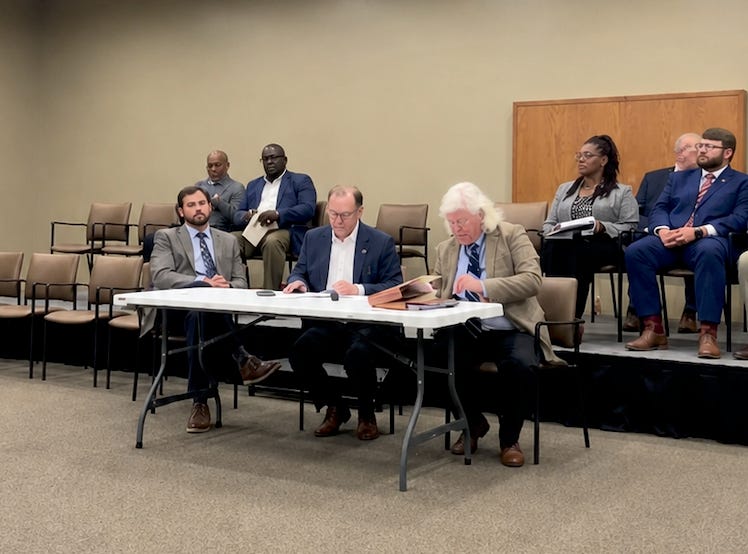
TUPELO, Miss.—One after another, the majority of people who stood at the microphone at a hearing here on Tuesday told the state’s redistricting committee the same thing: Do not redraw electoral maps.
During a roughly hour-long hearing at Itawamba Community College, a pastor, the president of the state NAACP, a Democratic Party official, a woman who came straight from work, and a man who moved to Mississippi from Chicago all urged the panel to leave the state’s current districts in place, arguing that there is no legal reason to change them and every reason not to.
The hearing was the first of eight that the Joint Committee on Reapportionment and Redistricting will hold across the state through Sept. 24, 2026, before the Mississippi Legislature takes up crafting new maps for its state legislative, judicial and congressional districts. Sen. Dean Kirby of Rankin County, the committee’s chair, opened by telling the audience the panel had come “to listen, not to answer questions, not to make speeches, not to politic.” Speakers were held to five minutes each. Nearly all of them used the time to oppose the exercise that brought the committee to town.
The Rev. Jeffrey Gladney, a pastor from Shannon who chairs a group called Lee County Get Out to Vote, spoke first and framed the stakes around the seat held by U.S. Rep. Bennie Thompson, whose Second District he lives in. “There is nothing in the Callais case that says Mississippi has to draw new maps,” Gladney said, arguing that redrawing the lines would split neighborhoods and cost majority-Black communities their representation. If the maps were redrawn, he said, “we would lose his influence, his voice and the resources that he’s able to bring back to his district.”
The Rev. Robert James, president of the Mississippi State Conference of the NAACP, told the committee that partisanship in the state has long served as “a pretext for race” and warned that reverting to older maps would reveal intentional discrimination. Anna Cunningham, speaking for the NAACP and the Mississippi Black Women’s Roundtable, reduced her testimony to two points: “Do not change the maps,” she said, adding that the committee should consider the public’s testimony “collectively and thoughtfully.” The 2025 maps, she noted, were drawn by legislators and approved by a court, and no census has been taken since to justify redrawing them.
The objections came in many registers. Chris Traylor asked the panel why the state would change something that works. “If 87 is working in my car, I don’t need 89 [octane] gas,” he said, then pressed for a reason that no one on the committee would give him, because the members had said at the outset they would not answer questions. Katie Gilbert, a Tupelo native, tied the effort to the state’s loss of young people. “It’s the backward thinking like this decision to redistrict Mississippi when we don’t have to, that keeps Mississippi stuck in the past,” she said, noting that Tupelo is already split among four districts.
Jim Newman, chair of the Lee County Democratic Party, put the process in a national frame, tracing it to President Donald Trump’s push for Republican-friendly maps in Texas and pointing to Georgia, where he said lawmakers recessed and declined to redistrict after large crowds turned out. “You want to get rid of the one black representative they have?” Newman asked. Walter Jones, a Mississippi transplant who lives near Emmett Till’s old home, said the state had been improving and that redrawing the maps would carry it backward. Charles Moore, president of the Lee County NAACP branch, urged the committee to “let the old Confederacy go.”
Two speakers struck a different note. Mike Walker said he represented his grandchildren and the state, and told the room the fight was “good versus evil,” not Democrat versus Republican. Bonnie Bear, who described herself as a concerned citizen, urged the committee, if it proceeds, to weigh the “disparate impact” the Callais decision removed from the legal calculation, and to consider the representation it would take away.
The testimony echoed a position the state’s Black lawmakers had already put in writing. In a letter sent in June to House Speaker Jason White and Lt. Gov. Delbert Hosemann, the leaders of the Mississippi Legislative Black Caucus, House Minority Leader Rep. Robert Johnson, Senate Minority Leader Sen. Derrick Simmons and caucus chair Rep. Kabir Karriem argued that there is no need for mid-decade redistricting and that the U.S. Supreme Court’s decision in Louisiana v. Callais does not require it. Mississippi is about 38 percent Black, the letter noted, yet Black voters have the opportunity to elect a candidate of their choice in only one of four congressional districts, 16 of 52 state Senate districts, and one of nine seats on the state Supreme Court.
Kirby told the audience the Supreme Court’s ruling “has changed everything,” and that the committee’s priorities are the legislative and Supreme Court maps. It is widely expected that Gov. Tate Reeves will call a special session later this year to redraw legislative districts before the 2027 qualifying period, with congressional and judicial maps left for the regular session.
Those who cannot attend the committee hearings can send written comments to the committee’s staff counsel. The next hearing is Aug. 27, 2026, in Senatobia.
Image: Members of the legislative committee at the Tupelo hearing (credit Derrion Arrington)
