


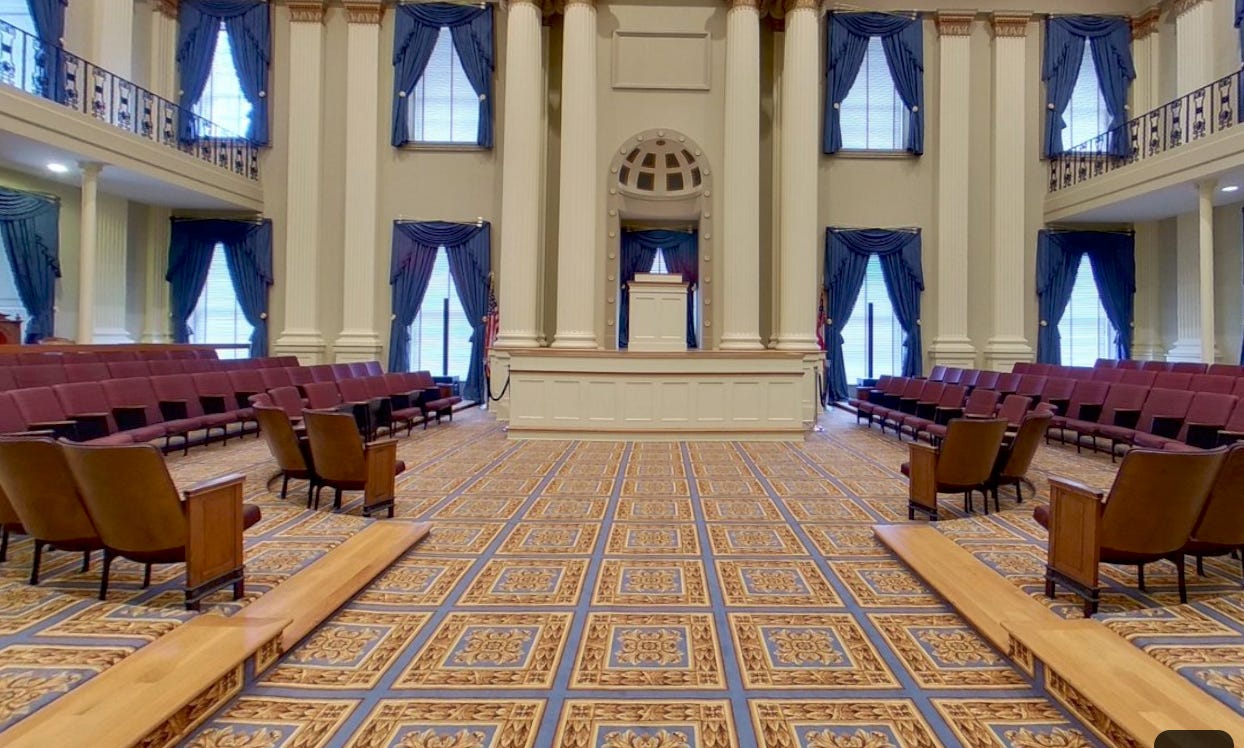
On Aug. 12, 1890, 134 delegates assembled at the Mississippi state capitol in Jackson to write a new state constitution. The capitol then was what is now the Old Capitol Museum, the same building where the Mississippi Legislature will reconvene on May 20, 2026, to redraw state Supreme Court electoral districts that a federal court has found violate Section 2 of the Voting Rights Act.
Legislators point to ongoing renovations of the House chambers in the existing “new” capitol as the reason for the change of venue. Yet there are also noteworthy precedents.
Among the delegates to the 1890 convention, 133 were white. The single Black delegate was Isaiah T. Montgomery of Bolivar County, a former enslaved worker of Joseph Davis, brother of Confederate President Jefferson Davis, and founder of the all-Black town of Mound Bayou.
The convention’s president, Solomon Saladin Calhoon of Hinds County, named the body’s purpose without qualification on the floor.
“Let’s tell the truth if it bursts the bottom of the Universe,” Calhoon said. “We came here to exclude the Negro. Nothing short of this.”
Calhoon’s remarks and those of other delegates appear in the convention’s 1890 Journal of Proceedings, the official record of its debates.
R.H. Thompson, a delegate and prominent state lawyer, told the floor that the franchise architecture being drafted was “never intended to be carried out faithfully” and would “be so administered as to exclude the negro voters, hardly one of whom will be eligible under it, and so as not to exclude the ignorant white voter.”
George P. Melchior of Bolivar County, who held his seat on the same “fusion” ticket as Montgomery, told the convention that “it is the manifest intention of this Convention to secure to the State of Mississippi, white supremacy.” The fusion ticket was a localized political arrangement under which white Democrats and Black Republicans in three Delta counties shared offices proportionally rather than contesting each election.
Lawmakers gathering on May 20, 2026, are not entering that chamber as a deliberate gesture toward the building’s history. The New Capitol’s House Chamber is closed for dome and skylight renovations through December 2026, and the Old Capitol House Chamber is the available venue. Yet the symbolism is hard to ignore.
The convention was led by James Z. George, a sitting United States senator from Mississippi. Federal officeholding did not bar a person from serving as a state constitutional convention delegate, and George’s national prominence and prior role organizing the 1875 paramilitary campaign that drove Mississippi’s Reconstruction-era Black officeholders from office made him the popular choice to lead the committee. He continued serving in the Senate through the convention and until his death in 1897.
George, who had been elected to the U.S. Senate by the 1881 Mississippi Legislature, chaired the convention’s franchise committee with two structural commitments. The architecture would eliminate Black voters without barring illiterate whites, and the disfranchisement would be accomplished through devices that were race-neutral on their face but selectively administered in practice.
The committee delivered Section 244’s “understanding clause,” which required voters to read and interpret a section of the constitution to a registrar’s satisfaction. It paired the clause with a two-year state residency, a one-year district residency, a poll tax and a list of disqualifying offenses that excluded crimes Black Mississippians were considered more likely to be convicted of while omitting murder and rape. The constitution was not submitted to voters for ratification.
Convention delegates drafted Article XII of the constitution Mississippi adopted on November 1, 1890. The architecture worked as the franchise committee designed it. Among approximately 109,000 white Mississippians of voting age and approximately 149,000 Black Mississippians of voting age in 1890, the registration rolls of 1892 recorded 68,127 white voters and 8,615 Black voters. By 1900, the fusion arrangements that had survived in three river counties had ended, and the political class of universal male suffrage constituted in 1870 had been entirely removed from the institutional architecture by which Mississippi was governed. The 1890 Constitution, with amendments, governs the state today.
The federal response to the framework that convention erected took 75 years. The Voting Rights Act of 1965 was passed to dismantle the disfranchisement architecture Mississippi pioneered and the rest of the South had adopted by 1908. Section 2 of the Act, the provision the Mississippi Supreme Court districts have now been found to violate, prohibits voting practices that result in the abridgment of the right to vote on the basis of race, regardless of whether the practice was adopted with discriminatory intent. The poll tax fell. The literacy test fell. The understanding clause fell. The 1890 Constitution itself remained in force. Mississippi did not repeal Section 244 from its constitution until 1975, 10 years after the federal statute had nominally invalidated it.
Ninety years after Calhoon’s convention, on Jan. 9, 1980, the Mississippi Legislative Black Caucus marked its formal establishment with a ceremony in the same Old Capitol House Chamber. The caucus had been operating informally since 1976, when Robert Clark of Holmes County, who had served alone in the legislature since 1968 as the first Black lawmaker since Reconstruction, was joined by three other Black House members. The 1980 ceremony recognized the larger cohort that had taken office that month, the result of a federal court ruling in Connor v. Johnson the previous year that ordered the Mississippi Legislature reapportioned into single-member districts and produced 13 additional Black legislators. Reuben Anderson, who would become the first Black justice of the Mississippi Supreme Court in 1985, administered the oath. E.C. Foster of Jackson State University delivered a brief historical address.
That ceremony, like the May 20 special session that follows it by 46 years, took place in the Old Capitol because the New Capitol was undergoing renovations. The coincidence was not arranged. It was simply where the chambers happened to be. The meaning of swearing in the largest cohort of Black legislators since Reconstruction in the same room where the disfranchisement architecture had been written carried on its own. The room kept the meaning.
The May 20 special session is the third occasion in the sequence. Gov. Tate Reeves celebrated the U.S. Supreme Court’s April 29 ruling in Louisiana v. Callais on social media the day it came down. “First Dobbs. Now Callais. Just Mississippi and Louisiana down here saving our country!” the governor wrote. The Callais decision, which constrained the use of race in Section 2 remedies, started the 21-day clock Reeves had set in his April 23 proclamation. The Mississippi Legislature now has the legal opportunity, under the constraints Callais established, to redraw the Supreme Court electoral map that U.S. District Judge Sharion Aycock found in August 2025 violates Section 2 of the Voting Rights Act in the Central District. The map has not been redrawn since 1987.
Mississippi Democratic Party Chair Cheikh Taylor named the parallel publicly at an April 30, 2026, news conference. “And now they plan to do it in the Old Capitol,” Taylor said, “the same building where Mississippi voted to secede from the Union over slavery, and where white supremacist delegates crafted the 1890 Constitution that stripped Black citizens of their voting rights.”
Recognition of the uneasy parallels is based on a structural argument, independent of intent. The Voting Rights Act of 1965 was passed to dismantle the framework written in the Old Capitol in 1890. The 1980 ceremony in the Old Capitol marked the institutional emergence of the Black political class that the Voting Rights Act made possible. The 2026 session in the Old Capitol will redraw, under federal court order, a map that the Voting Rights Act has been used to challenge. Three points in the same room. The first codified the disfranchisement. The second institutionalized the response to it. The third will adjudicate, under a Supreme Court ruling that has narrowed the available remedies, what is left of the response.
The substance of what lawmakers do on May 20 will outlast the symbolism of where they do it. The building has not been a neutral container at any of the three points in this sequence, and there is no reason to expect it to become one now.
Calhoon stood in that chamber and named what he was there to do. The legislators who followed him in 1980 stood in the same chamber and named what they were there to do. The legislators who arrive on May 20 will be doing what a federal court has ordered them to do, under constraints the U.S. Supreme Court imposed three weeks earlier, in a building whose history neither they nor the governor who summoned them chose.
Yet the room keeps producing the same kind of moment. Whatever map emerges from the Old Capitol will return to Judge Aycock’s court. The Voting Rights Act, written to undo what was written in that building, is the standard against which the result will be measured.
Image: Old Capitol House chambers (via Old Capitol Museum)
