


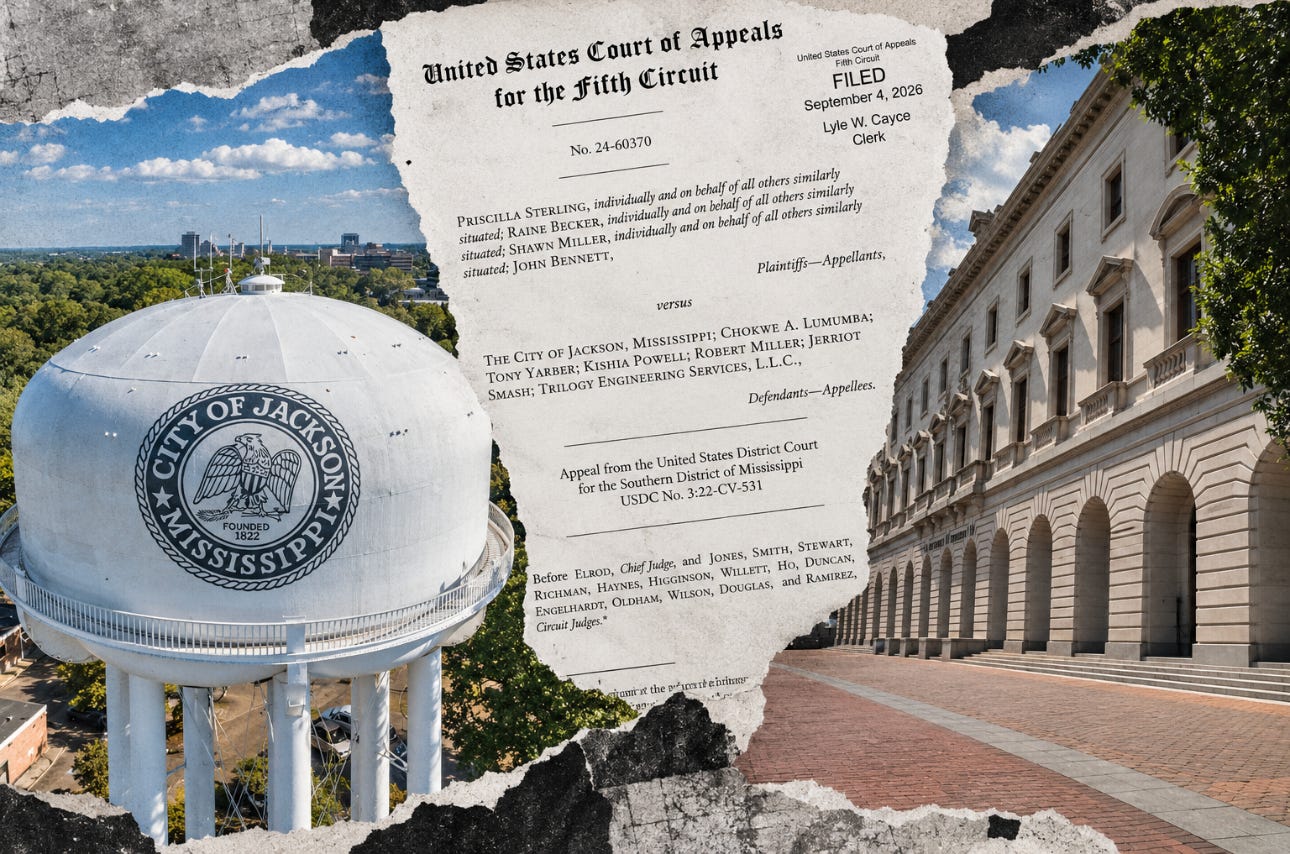
When the full Fifth Circuit U.S. Court of Appeals ruled on Sept. 4, 2026, that four Jackson residents could not sue the city or its former officials over lead in their drinking water, the decision made national news, usually under headlines announcing that the court had ruled there is no constitutional right to clean water.
In reality, the appellate judges’ majority opinion notes that the plaintiffs had dropped their initial claims that such a right existed.
“Despite beginning the complaint with the assertion that ‘[a]ccess to clean, poison-free water is a fundamental human right,’ Plaintiffs now disclaim reliance on a right to clean water and a right to the provision of competent municipal services,” Judge Kurt Engelhardt wrote for the majority in the ruling.
The Fifth Circuit, based in New Orleans, is one of 13 federal appellate courts and covers cases in parts of Louisiana, Mississippi and Texas.
The ruling’s lack of bearing on the right to clean water was further muddied by reports referencing a previous United Nations resolution recognizing “the right to safe and clean drinking water and sanitation as a human right that is essential for the full enjoyment of life and all human rights.” That resolution was unrelated to the Fifth Circuit case.
The case at issue was Sterling v. City of Jackson. Priscilla Sterling, Raine Becker, Shawn Miller and John Bennett sued in 2022 on behalf of a proposed class of Jackson residents. The defendants included the city, former mayors Chokwe A. Lumumba and Tony Yarber, former public works officials Kishia Powell, Robert Miller and Jerriot Smash, and Trilogy Engineering Services. Judges Leslie Southwick and James Graves recused themselves from the case. Federal judges aren’t required to explain why they choose to recuse themselves and neither Southwick nor Graves did.
By the time the case reached the full court, the plaintiffs’ argument was based on two established, substantive due-process theories. The first was bodily integrity, the principle that a government may not physically intrude upon a person without justification. The second was state-created danger, the doctrine that a government which affirmatively puts someone in harm’s way can be required to answer for what follows.
The Fifth Circuit’s majority described the claims differently, as asserting rights “(1) to not be exposed to water that was contaminated as a result of the acts or omissions of public officials and (2) to truthful information from public officials about the presence of contaminants in municipally supplied drinking water.” Judge Catharina Haynes, writing for the five members who would have let the case go forward, said that description left out half the case.
“If one were to read only the en banc majority opinion, they could be forgiven for misunderstanding Plaintiffs’ allegations,” Haynes wrote. En banc—French for “on bench”—means all the judges of a court sit to hear a case. What the plaintiffs filed, she said, was “a class action asserting two substantive due process claims—bodily integrity and state-created danger.” Her dissenting opinion notes that the state-created danger theory is never mentioned in the majority ruling.
The majority addresses why any of this ran through the Constitution at all. “Our sympathies cannot be the basis for transforming quintessential tort claims into 42 U.S.C. § 1983 claims,” Engelhardt wrote.
Section 1983 is the Reconstruction-era statute that lets people sue state and local officials for violating federal rights. It creates no rights on its own but supplies a vehicle for enforcing rights that come from somewhere else. For plaintiffs in the Jackson water case, that somewhere else had to be the Fourteenth Amendment. Strip out the federal right and the federal case goes with it, which is what happened. The plaintiffs had also brought state tort claims. Once the constitutional claims failed, the district court declined to keep the tort claims in federal court and dismissed them without prejudice, and the Fifth Circuit affirmed that too. A dismissal without prejudice means the claims were never ruled on one way or the other, so the plaintiffs can bring them again in state court.
The majority applied the history-and-tradition test the Supreme Court used in Washington v. Glucksberg and again in Dobbs v. Jackson Women’s Health Organization. Under that test, an unenumerated right must be deeply rooted in the nation’s history before a court will recognize it. On bodily integrity, the court ran through the cases where the right has applied, which involve forced surgery, forced stomach-pumping, involuntary medication and sexual assault by an officer, and found lead exposure “wholly different.” As for truthful information, it leaned on two Second Circuit decisions about federal statements on air quality in New York City after Sept. 11, 2001, and declined “to expand substantive due process to render public officials liable for statements made during an evolving public crisis.”
Matthew Steffey, a professor at Mississippi College School of Law who teaches constitutional law, described how that test works. “They apply a test that basically says, would people a hundred years ago have considered this a constitutional right, and the answer to that is almost always no,” Steffey told The Mississippi Independent. “That’s the whole purpose of employing that legal standard, because it gives the answer no.”
The court also held that qualified immunity would have protected the individual officials in any event. Haynes agreed with that part. The dissenters split from the majority on whether the claims were cognizable, which is legalize for knowable, and on whether the case should have been thrown out before discovery.
Steffey described qualified immunity as a second barrier that operates even when a claim is otherwise valid. “All the official has to say is, well, now we know we can’t do this, but at the time that wasn’t clearly established,” he said. “Qualified immunity is like the one free bite rule. The first time they violate your rights in a particular way, they’re still off the hook.”
The state-created danger claim drew no judicial analysis. Haynes places that silence in a longer pattern. Ten of the Fifth Circuit’s sister circuits have adopted the doctrine, she wrote, while the Fifth Circuit “stands practically alone in its decades-long fence-sitting, declining to either adopt or definitively rule out the state-created danger doctrine.”
In Fisher v. Moore, in 2023, the Fifth Circuit passed on the doctrine again and cited the absence of “meticulous briefing on how state-created danger liability meets today’s reinvigorated test.” The Sterling plaintiffs, according to Haynes, told the court they “readily accept[ed]” that invitation and briefed it. The court heard argument on the question, including from outside parties. The majority opinion does not take it up.
Lily M. Reed documented the same pattern five months before the ruling in a Baylor Law Review article titled “Deliberately Out of Step,” tracing the court’s refusals across two decades and arguing that the result is unequal constitutional protection for people living in Texas, Louisiana and Mississippi.
On bodily integrity, the decision creates a direct conflict. In 2019, in Guertin v. Michigan, the Sixth Circuit allowed Flint residents to proceed on that theory against officials who switched the city’s water source, calling the right indispensable, a first among equals, and possessed of an impressive constitutional pedigree. That court reaffirmed the approach last year in Mitchell v. City of Benton Harbor. Engelhardt addressed Guertin in a footnote. “We are not bound, nor persuaded, by Guertin.”
A resident who brings a bodily-integrity claim over contaminated municipal water in Michigan can get past a motion to dismiss. A resident who brings the same claim in Mississippi cannot.
Jonathan Adler, the Tazewell Taylor Professor of Law at William and Mary Law School, wrote four days after the decision that the split “would seem to create an opportunity for Supreme Court review,” He added a second point: “It is difficult to see the Supreme Court being any more sympathetic to the plaintiffs’ claims here than was the Fifth Circuit.”
The majority made that argument itself. It noted that the EPA and the Mississippi State Department of Health have monitored the city’s water for years and that the federal government now manages the system, and it pointed the plaintiffs toward tort suits, toward petitioning their legislatures and toward electing officials “who will better manage the water system.”
Steffey addressed both. “The Fifth Circuit is the worst place in the country to try to make a claim like this,” he said. “And just like the Mississippi Legislature is the worst place in the country to go looking for help.”
Haynes’s account of the record runs differently. She writes that Yarber was aware the city’s treatment plants “were incapable of adequately treating the water” to prevent corrosion of the pipes and scrapped plans to fix it; that the city made a “catastrophic” switch from high-pH well water to low-pH surface water that caused a serious increase in lead levels; that officials told the press the water was “not unsafe” to drink while knowing otherwise; and that the city sat on a 2020 EPA emergency order documenting numerous violations for a year. Several of Sterling’s children, the complaint says, have been diagnosed with lead poisoning.
Mark Chalos of Lieff Cabraser, who represents the residents, has not said publicly whether he will seek U.S. Supreme Court review. A petition would be due roughly 90 days from the Sept. 4 judgment, putting the deadline in early December.
The decision leaves untouched the other litigation over Jackson’s water system. The 2022 Safe Drinking Water Act action brought by the U.S. Justice Department remains before U.S. District Judge Carlton Reeves, along with the federal third-party manager installed under it, and the majority opinion cites that case approvingly. A separate NAACP suit filed in August 2025 over the distribution of federal water money is also pending.
The holding is not limited to lead or to Jackson. It reaches sewage, industrial exposure and any claim that a Mississippi, Louisiana or Texas local government injured someone through the way it ran a public utility and then described it inaccurately. For those claims the federal option has narrowed to what a statute specifically provides, and what is left belongs in state court under a tort law written to limit what governments pay.
“Whatever the remedy for the water problem is, that remedy does not lie in a federal court action for damages,” Steffey said. “That door is closed to citizens and all these other municipalities or small water jurisdictions.”
Photo illustration by Derrion Arrington
