


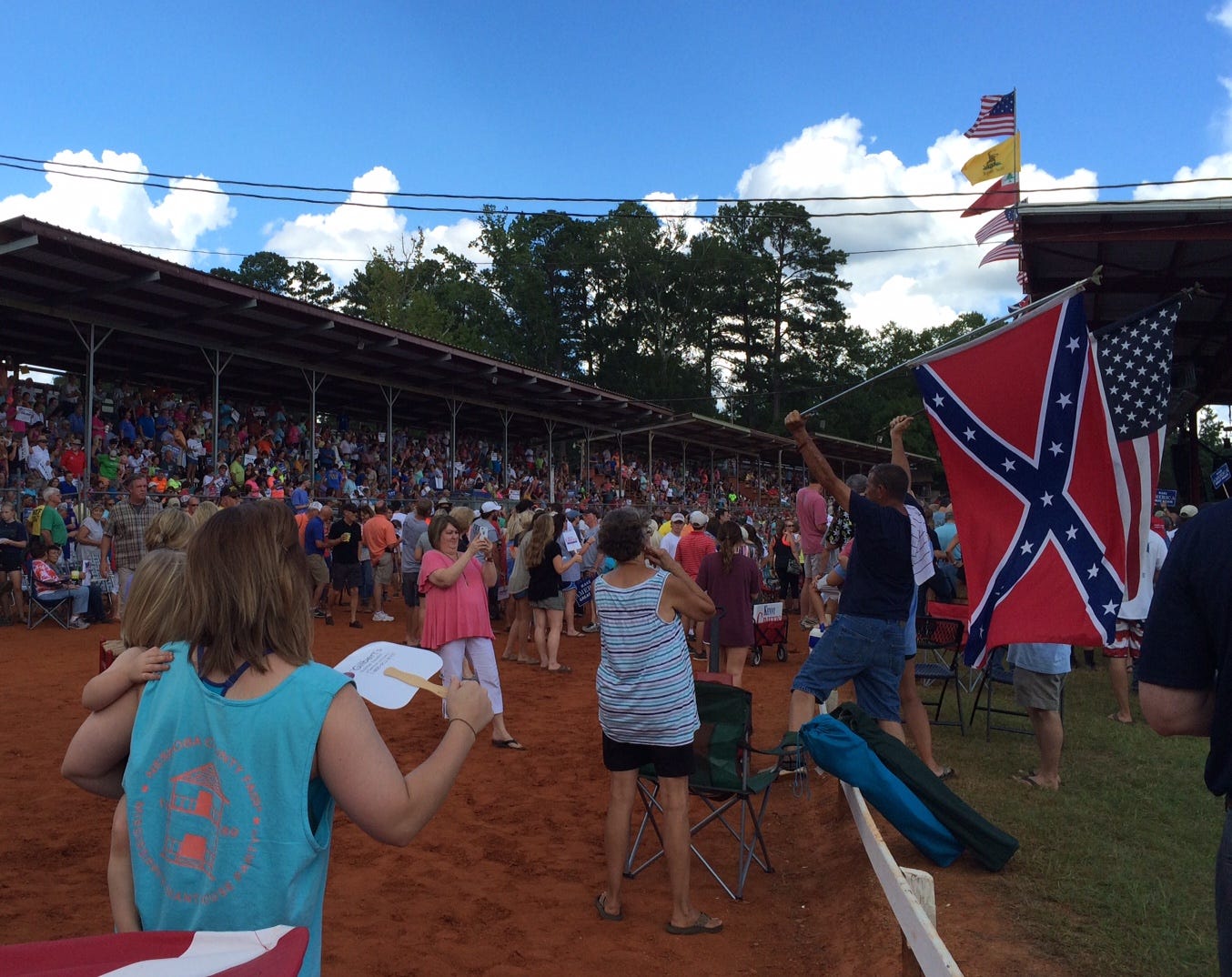
The Neshoba County Fair opens today, and next week Mississippi’s political class will again gather beneath the oaks of Founder’s Square. Though fair attendees have grown more diverse in recent years, the multi-day camp gathering remains a key venue for conservative politicking—and for revisiting its racially charged history.
Political speeches are scheduled for Wednesday and Thursday, June 24 and 25. Gov. Tate Reeves closes the program on Thursday, the marquee slot, after Secretary of State Michael Watson and House Speaker Jason White.
Two of this year’s speakers are preparing statewide campaigns for 2027: Agriculture Commissioner Andy Gipson for governor and Watson for lieutenant governor. That makes the fair once again both a stage for reflection and a launching point for the next election cycle.
The setting is the same as it has been since 1889, with a network of wooden cabins arranged along footpaths, a central square and a horse-racing track. The location in Neshoba County is otherwise freighted: The fairgrounds are a few miles from the site where, in the summer of 1964, three civil rights workers—James Chaney, Michael Schwerner and Andrew Goodman—were murdered by Ku Klux Klan members while working to register Black voters. Their deaths became emblematic of the violent resistance to Black political participation during Freedom Summer and remain among the more notorious crimes of the civil rights era.
Sixteen years later, on Aug. 3, 1980, Ronald Reagan delivered his first major campaign speech at the fair after winning the Republican presidential nomination. Addressing a crowd of roughly 10,000, he tellingly declared, “I believe in states’ rights.” Republican strategists had chosen the Neshoba County Fair deliberately, as part of an effort to win rural Southern voters and break incumbent President Jimmy Carter’s hold on the region. A Mississippi Republican national committeeman had urged Reagan to speak at the fair because it would help win over “George Wallace-inclined voters.” The strategy was to court segregationists.
Everyone understood what Reagan’s terminology meant. New York Times columnist Bob Herbert later wrote that everyone watching the 1980 campaign knew what Reagan was signaling at the fair, and that when politicians invoked states’ rights to white audiences in a place like Neshoba County, the message understood on the ground was that in any conflict between white and Black voters, the speaker was on the white side. The newspaper’s contemporaneous coverage linked the location to the murders directly; reporter Douglas Kneeland noted that Reagan was appearing at a fair outside Philadelphia, Mississippi, near where the three civil rights workers had been slain in 1964.
The subtext became text the following year, when Reagan political operative Lee Atwater described the evolution of the Southern Strategy in a 1981 interview. The strategy, Atwater explained, had moved from open use of racial slurs in the 1950s to abstractions by the late 1960s—“forced busing, states’ rights, and all that stuff”—because the open slur had begun to backfire. The location was key to the message. The words were the delivery system. Civil rights leader Andrew Young wrote at the time that Chaney, Goodman and Schwerner had been murdered in Neshoba County for trying to register Black voters, and asked what states’ rights a Reagan administration would revive.
The Neshoba County Fair has long been Mississippi’s premier conservative political stage. Dozens of speeches are scheduled over multiple days each year, and every Mississippi governor since 1896 has attended at least one session. Presidential candidates including Reagan, Michael Dukakis, Jack Kemp and John Glenn have spoken there, though national candidates have been less in evidence in recent years. Donald Trump Jr. appeared in 2016 on his father’s behalf and remarked about standing on the same stage from which Reagan had launched his 1980 campaign. The lineage—Reagan’s 1980 appearance as a defining moment—is explicit and celebrated.
The continuity of rhetoric and strategy was made plain in 2024. Reeves invoked Donald Trump in rallying the crowd, while Gipson framed Trump’s survival of an assassination attempt as evidence of resilience and urged fairgoers to oppose “liberal threats” and “global liberalism.” The speeches emphasized partisan loyalty over policy, demonstrating the fair’s enduring function as a site for reinforcing conservative political identity.
By 2025, the coded language had evolved while the essential message held. On July 31, 2025, Reeves emphasized “education freedom,” including proposals to consolidate school districts, while White framed the effort as aligned with federal incentives for “school choice”—policies that supporters say empower parents and that critics argue undermine public education and deepen inequality. Reeves repeatedly invoked “Mississippi values,” “conservative values” and the “Mississippi way of life,” portraying state policy as a model of ideological and cultural success, and he placed himself directly in Reagan’s lineage. “Before Tate Reeves got into politics, I started coming to the fair back in the eighties, when folks like Reagan and Dukakis were speaking, and I’ve loved it ever since,” Reeves told fairgoers, making an explicit claim on the historical and symbolic weight of speaking at Neshoba.
The fair’s symbolic power comes from its history. Speaking at Neshoba often signals a politician’s alignment with the racial and political sensibilities of the state’s conservative electorate. The fair is not a uniformly Republican space—Democrats have long spoken from the same stage, attend in numbers, and keep their own cabins in a section known as Happy Hollow—but the political program and the crowd it draws lean heavily Republican, and the speakers who command the marquee slots are almost entirely from the party that now controls every statewide office.
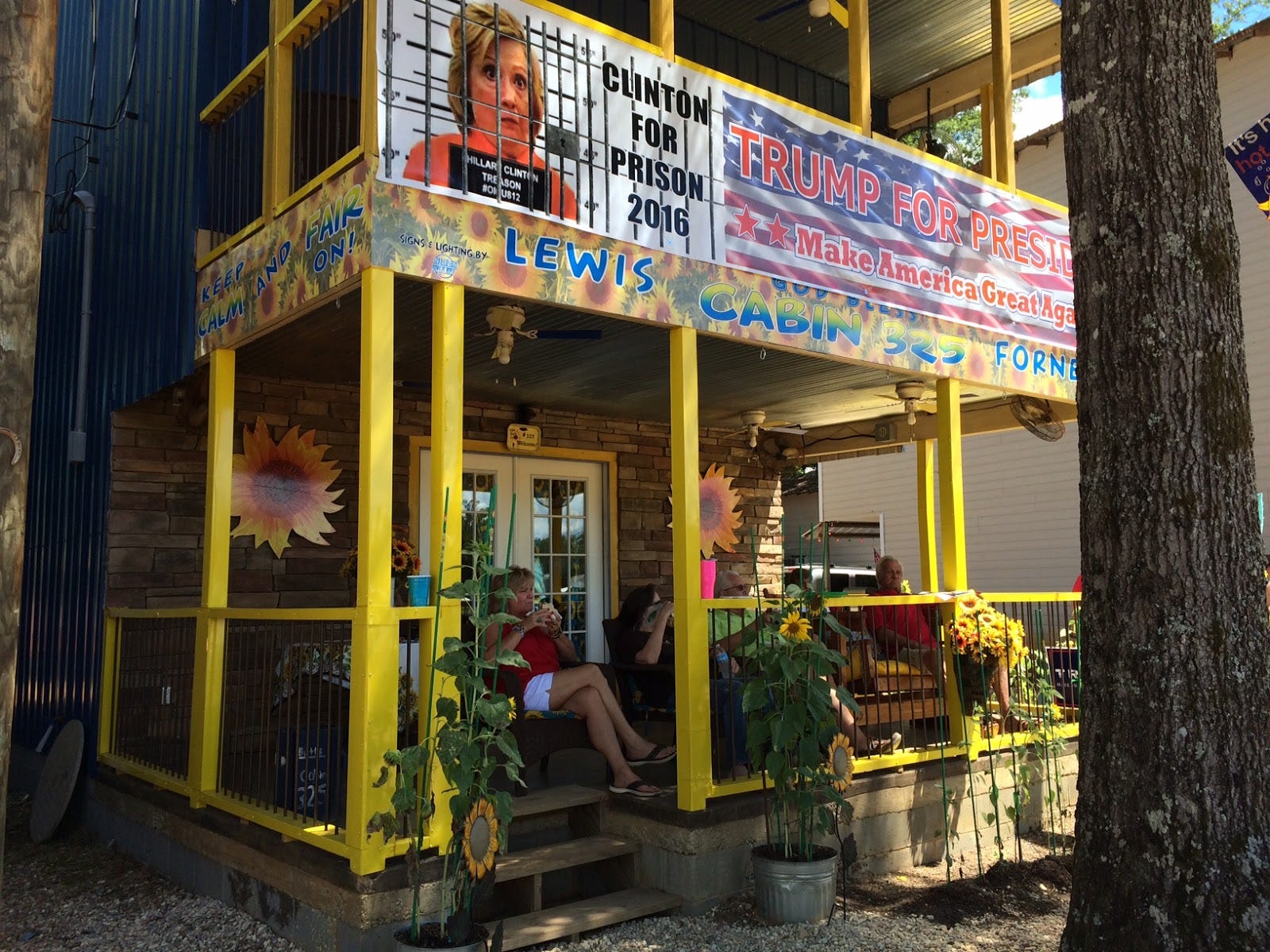
The rhetoric of 2025 closely mirrored that of 1980. Reagan’s coded appeals to racial and cultural anxiety were reframed as invocations of “conservative values” and “education freedom,” yet the underlying function—appealing to white voters while signaling resistance to federal intervention and progressive policy—remained. Policies such as school consolidation and school choice echoed the “freedom of choice” plans of the 1960s, which facilitated white flight from desegregated schools.
The coordination between federal incentives and state legislation reflects a strategic continuity that runs back decades.
The normalization is the point. Mississippi politicians continue to speak at a site that summons the region’s historic racial violence, employing the same coded language Reagan used, appealing to the same impulses with updated targets. Despite the characterization of the fair as “Mississippi’s Giant House Party,” the tradition is not simply about hospitality. It involves impunity.
Standing a few miles from where the civil rights workers were murdered, and where Reagan launched a campaign appealing to segregationists, Reeves in 2025 called Mississippi “a blueprint and a model” for the nation. Next week he will have the last word at Founder’s Square, again.
Images: A man sends conflicting messages by carrying both a Confederate and a U.S. flag on the fairgrounds racetrack in 2016; a fair cabin draped with a partisan banner the same year (both by Alan Huffman)
