


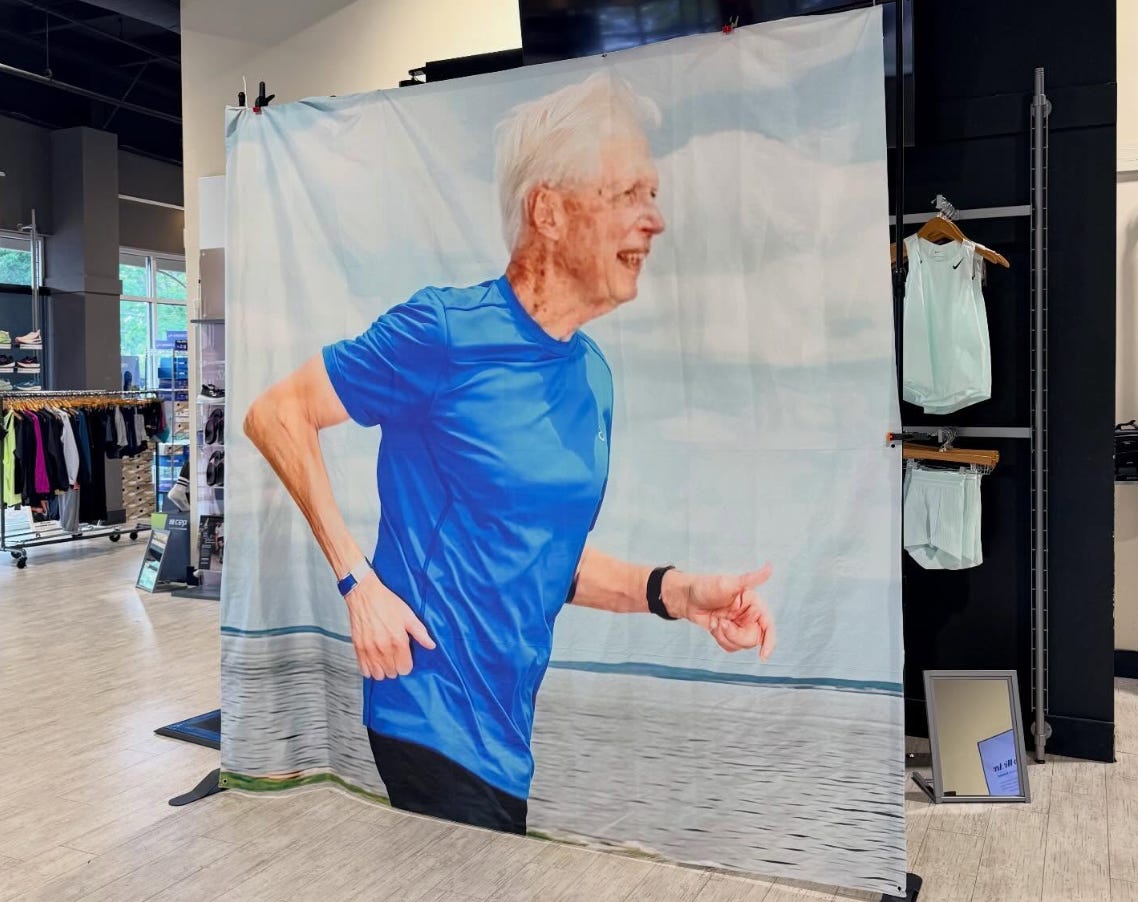
When the Ridgeland, Mississippi running store Fleet Feet posted on Facebook about Richard Edmonson’s birthday, it wasn’t a typical customer shout-out.
Edmonson was turning 88 and still an active runner. At a stage of life when most of his peers are happy just to be alive and ambulatory, Edmonson has completed 32 half-marathons as well as one full marathon, and he continues to run local routes even during the heat of summer.
For avid runners of any age, avoiding strenuous exercise during periods of high heat and humidity isn’t really an option, unless you reduce yourself to running on a treadmill in an air-conditioned gym. For those who take to the streets or trails, the old adage does not apply that only mad dogs and Englishmen go out in the midday sun.
Doing it at age 88 is next level. Consider the prevailing image of someone pushing 90 years old. Then imagine that person running, for miles, even in the summer sun. That’s Richard Edmonson.
Edmonson, a retired lawyer, has unique insights into both the aging process and how to adapt a running regimen to feels-like temps that bump 100 degrees or more, which can be particularly challenging for older runners whose bodies are less efficient at expending heat and whose physical strength and stamina are on the wane. Edmonson said he makes a few strategic concessions to running during the summer months, but that for the most part it’s just a matter of staying attuned to your body.
“I try to run in the early morning,” Edmonson told The Mississippi Independent. “I cut back on my mileage some in summer—six to eight miles is my typical long run, while I might run eight to 10 miles in winter.”
As for the age issue, Edmonson concedes he doesn’t have quite the stamina in his eighties that he had at age 70, when he began running, and now more often runs 5K and 10K races (3.1 to 6.2 miles) rather than half-marathons. Among the endurance races he has run is Jackson, Mississippi’s Fondren Urban Ultra, a 12-hour timed race in which runners choose distances up to 100k. Edmonson ran 26 miles.
Most running sites categorize older runners as over age 50, but among those listed on the Ultra Signup website, which reports endurance races and results across the United States, many are in their seventies, eighties and even nineties. The website for Ultra Running Magazine lists Jackson’s Urban Ultra as the most recent race for Aaron Goldman of Los Alamos, New Mexico, who is reportedly 94 and has run 37 races since 1992. Yet Goldman’s name does not appear in this race report for runners over 70 who participated in the race that year (2024). According to the report, Edmonson was the oldest entrant.
In 1984, Stanford University launched a study of runners over age 50 that would span their running careers across 21 years. By 2005, when the study concluded, many of the runners had quit or died, but among those who were still running, there appeared to be a commonality that contributed to their ability to stay at it: Those with the best outcomes tended to lay off running at the first sign of injury or other notable physical duress, yet tended to recuperate for shorter periods. One takeaway is that it’s important to push yourself, even in the face of physical stress, but also to recognize trouble, cut back if necessary, then get back at it as soon as possible. Runners who insisted on powering through injuries as well as those who laid off for long periods tended to have worse outcomes. Finding the sweet spot, even when it seems contraindicated, seems to be a solid approach.
Among 538 runners who participated in the Stanford study, 284 were still running in 2005, when all of them were over 70. The study concluded that running in middle and older ages markedly reduced disability in later life and provided what the authors described as “a notable survival advantage.”
Edmonson said his personal credo as an aging runner is straightforward: “If you don’t keep on running, you get to the point that you can’t keep running.” In other words, not running ends up meaning not being able to run.
The same logic could apply to any runner’s regimen, regardless of age, as well as to the process of acclimating to summer heat—a major consideration now, when parts of Mississippi are under a heat advisory. Laying off running for a month or more basically takes you back to square one—you get little credit for having previously run, even if you did it for decades. Staying with it is crucial.
Edmonson said he took up running late in life, at 70, which, he noted, “is kind of backward,” given that people are more likely to give up running around that age (and, in fact, most quit much earlier).
In his first race, Edmonson plunged into the heat of summer in Jackson’s July 4, 2008, Watermelon Classic 5K—a race he also ran this year. A former longtime swimmer, he said he had grown bored with that sport, and after his wife and eldest son (who introduced him to road racing) died in close succession,running helped him cope with grief. “Running,” he told Runner’s World magazine in a 2020 profile, “helped me find comfort in my discomfort.”
Finding comfort in discomfort is a useful approach for any runner attempting to push their limits, whether that means covering a long distance, dealing with extreme heat, adapting to the process of aging—or all of the above. It’s also why many runners are attracted to races like the upcoming Big Butts, Mississippi’s most infamous annual summer endurance race, which this year will take place on July 18 along the trails of Jackson’s Buddy Butts Park and an adjacent cross-country course known as Choctaw Trails.
Big Butts give runners the option of a 25K, 50K or 100K (about 15.5 to 62 miles) or a group relay for longer segments. Though the race begins at 7 a.m., it is invariably hot from start to finish. It’s all about enduring hours in sweat-sodden, chafing shorts and shoes, obsessively hydrating, coping with discomforts like swollen fingers and leg cramps, and pondering existential questions such as: Why, exactly, am I doing this?
For most participants, the point is to push your limits and live to tell the tale. Individual race times vary wildly: Big Butts has a cutoff point of 14 hours for longer segments and seven hours for the 25K.
Those of us who are old enough to remember when running was the sole province of track and field athletes—as Edmonson pointed out, “People would have thought I was crazy if I’d run the roads when I was growing up”—tend to reduce their running pace over time and most are fine with that. As Edmonson observed, older runners mainly compete with themselves and time. In summer, they also compete with the weather.
Big Butts runners tend to range in age from their teens to their fifties, though last year’s race attracted two 50K runners in the 60-69 age category and seven for the 25K (one of whom did not finish). Other area endurance races skew younger, including Kick Up the Dust (4K, 8K or 14K, Butts/Choctaw trails, in April); the Bone Yard Trail Race (5K, 10m, 20m, 50k, near Brookhaven, in May); and the one-shot First Last Annual Clark Creek Trail Run (6m, 12m, Wilkinson County, complete insanity, September 2017).
Edmonson said he doesn’t run trail races like Big Butts because he’s concerned about the potential for falls. Dirt trails, which are typically maintained for mountain bikes, are riddled with tree roots, ditch crossings and repetitive changes in elevation, though the Butts Park hills are comparatively minor by ultrarace standards. Anyone who trail-runs knows that it is only a matter of time before you inevitably will trip and fall. On the upside, this teaches you how to fall, a potentially useful skill later in life. Partly because he has already suffered a broken hip, Edmonson chooses to run only along paved routes.
As for his regular running routine, Edmonson said he typically runs every other day, to give his body a day of recovery, and runs with a group because he likes the social aspects of a shared physical endeavor. “Runners are good people,” he observed. “Young or old, male or female, black or white, gay or straight—on the trail, you’re one thing: a runner.”
Unsurprisingly, members of Edmonson’s running group are much younger than him, and, he said, “My time is slow. In my seventies I could run with anybody, but when I hit 80 it got harder.” He said he aims for a pace of 14- to 15-minute miles. “You have to pay attention to your body,” he said. “My goal is to finish.”
For 50 years, Edmonson has also done strength training and currently works out for two hours in a gym, twice a week, both lower and upper body. To underscore the importance of doing this, he pointed to a Harvard University 30-year longevity study released on June 2, 2026, which demonstrated that combining strength training with cardio workouts resulted in significant decreases in mortality among study subjects. The study, published in the British Journal of Sports Medicine, found that people who did about 1.5 to 2 hours of muscle-strengthening weekly combined with regular cardio workouts were 45 percent less likely to die from any cause than people who did neither. That percentage was higher than for people who did only strength training or only aerobic workouts.
Edmonson said it’s important to keep everything in tune. “If you stop running, it would be so easy to sit in my easy chair and play on my computer and not do anything,” he said. “I do it for my health. It’s not only about your life span—it’s about your health span. I want to stay healthy and be with people.”
Runners take different approaches to dealing with vagaries like weather, types of routes, and age. I personally avoid running on pavement because it can stress aging joints. Edmonson said he has been able to avoid common running maladies such as knee and ankle issues, but he has had a hip replacement and surgery on his lower back. His hip replacement was a riff on a common theme for the elderly that was only tangentially related to his running. Following a run, he said, he was leaning against a post that suddenly broke, sending him tumbling to the ground and leaving him with a broken hip, which later had to be replaced. He has also experienced dangerous dehydration—a common problem during summer heat for which older runners are at increased risk.
Edmonson’s dehydration episode happened recently, he said, during a comparatively short four-mile run. “I got about a mile and a half into the run and felt really dizzy and nearly passed out,” he recalled. “It was because I wasn’t hydrated enough. Now, I take goo and electrolytes, and I carry water all the time, even for a three-mile run.”
This site runs through the list of how to avoid that risk, whatever your age: Hydrate before and during the run; watch for signs of potentially fatal heat illness, including dizziness, nausea, chills, confusion or decreased sweating; and check with your doctor beforehand if you have any notable medical condition or are on prescription drugs.
Beyond that, nutrition supplements and hydration gels are basic prerequisites for long summer runs. Though there are almost always aid stations with water and other refreshments along race routes, runners may be required to also carry their own refillable water containers.
For older runners, the body’s decreased blood circulation near the skin reduces its ability to release internal heat, which is why it’s important to be dutiful about hydration and make personal concessions to distance and time of day. It all goes back to paying close attention to your bodies’ cues, and making necessary adjustments.
Summer endurance races doubtless involve a healthy measure of misery. Though dealing with that and challenging yourself can also be exhilarating and oddly addictive, it’s not unusual for Big Butts runners to have to walk parts of the route, and some don’t finish. There are always standout runners in such races, even among the elders. In 2024, the winner of Big Butts in the oldest age group (60-69) was Greg Gearhart, of Clinton, Mississippi, aged 68, who again won among seven runners in that age group in 2025.
Although older runners are obvious outliers, in some ways that’s true of all runners in a state like Mississippi, which is not known as a bastion of fitness. The Centers for Disease Control reported the state ranks No. 1 for “physical inactivity prevalence,” which is a nice way of saying there are lots of people who rarely do anything more strenuous than walking to and from their car. More than 30 percent of Mississippi’s CDC survey respondents reported not having engaged in any physical activity outside of work during the previous month.
Perhaps not coincidentally, the World Population Review this year ranked Mississippi the second fattest state in the U.S., with about 40 percent of residents categorized as obese, based on body mass index. Meanwhile, there are fewer publicly sponsored incentives to exercise in Mississippi than in more progressive states. As evidence, Clinton’s community symbol is the bicycle, yet the city has no bike trails or bike lanes.
Still, there are many dedicated runners in Mississippi, including those like Edmonson who refuse to age out and who continue running even during the most challenging days of summer. There’s a tired bystander joke that sometimes gets lobbed at runners: “What are you running from?” The answer is pretty simple: death. Though mortality will eventually catch us all, the point is to give it a run for its money in the meantime.
At its core, as Edmonson and other older runners can attest, it’s about how a person ages and the decisions they make along the way. Some people start cutting back on athletic activity as early as their thirties, and not always by choice. Others, whether due to genetics, luck or determination, persevere. For Edmonson, the combination earned him that profile in Runner’s World, recently got him inducted into the Fleet Feet Jackson Hall of Fame, and now, had him fielding questions from an also-ran about late-life running in the Mississippi heat.
Athletes who manage to stay at it well past their prime are a source of public fascination, for good reason. The Washington Post recently reported on another study of older runners, including Italy’s Emma Maria Mazzenga, who holds a world record as a sprinter in the 90-94 age group and has run intermittently for 62 years (the researchers are also studying older champion distance runners to understand how they adapt to prolonged aerobic exercise). The article noted that at age 92, Mazzenga’s overall aerobic fitness was similar to that of an athletic woman almost half her age, and her body’s ability to transfer oxygen to her muscles was even better, comparable to what’s typically seen in an active 30-year-old. Her muscles also exhibited healthy connections to nerve cells in the spinal cord. Such connections often wither with age, reducing the ability of muscles to receive and respond to messages from the brain, yet few of Mazzenga’s nerve connections had died. “Her muscles’ mitochondria—the tiny organelles inside cells that absorb oxygen and transform it into energy—were exceptionally robust, functioning like those of a 20-year-old,” the newspaper reported.
Sprinting taxes the body in different ways than distance or endurance running, but all involve intense aerobic workouts that would be out of reach for most people, even those much younger than Mazzenga, Edmonson or Goldman.
Such endurance, including racing during the dog days of summer, requires a high level of commitment, as well as powering through difficulties and, inevitably, submitting to a period of recuperation. In some cases, it can also mean accepting the dreaded “did not finish” designation in posted race results.
The point is to try—to stay at it for as long as possible, and, in the words of poet Dylan Thomas, to “not go gentle into that good night.”
Image: Commemorative illustration of Richard Edmonson, from a photo originally published in Runner’s World, displayed at his 88th birthday celebration (via Fleet Feet running store Facebook page)