


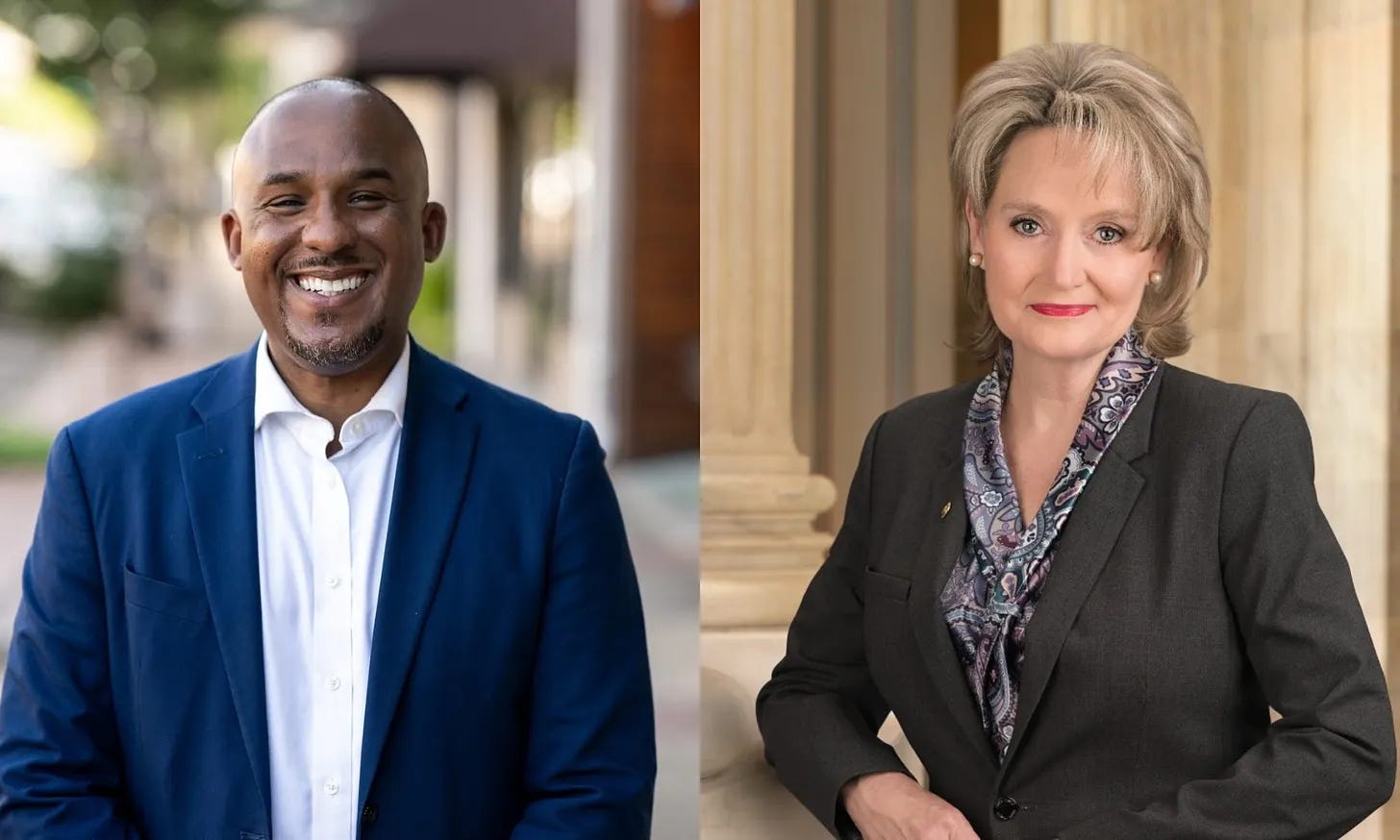
In a dispute that is likely a harbinger of more such controversies to come, Attorney General Lynn Fitch notified Scott Colom and his U.S. Senate campaign this morning that artificial intelligence ads the campaign posted to social media appear to violate the state’s deepfake law, and warned that they should be taken down.
If they are not, her office said, it may go to court for an injunction.
Colom afterward told Mississippi Today that he would delete the ad postings because he did not want Fitch to launch litigation using taxpayer money.
Fitch also asked Colom and his campaign to preserve all records related to the matter, her office said, “so as not to obstruct justice.”
Though the A.I. ad issue was raised by Republicans targeting a Democrat, in Georgia a similar controversy has erupted over Republican A.I.-generated ads aimed at a Democratic candidate, U.S. Sen. Jon Ossoff. With increasing use of A.I., it seems inevitable that there will be more such controversies.
There is nothing in Colom’s ad that indicates A.I. was used. Republican objections meanwhile ensure that the claims the ad makes will receive more attention.
The statute Fitch cited is Section 97-13-47 of the state code, which took effect in 2024. Her office noted that a violation carries up to five years in prison and a $10,000 fine where the intent is to deter a person from voting, and up to a year and $5,000 otherwise.
The statement stops short of a legal conclusion. It says the ads “appear to violate” the law and that the office “may file an injunction as authorized by law.” Nothing has been filed.
The notice came a day after the Mississippi Republican Party asked her to act.
Party chair Mike Hurst sent Fitch a seven-page letter on Oct. 22 asking her to investigate Colom, to seek an injunction against him, and to tell his campaign to preserve evidence. Fitch’s office posted the letter alongside its statement.
Hurst’s complaint concerns a 19-second video the campaign put on Facebook and Instagram on Oct. 1. It shows a woman made to resemble Hyde-Smith, called “Cindy” by a narrator, hurrying from a crowd of reporters holding cameras and microphones before she gets into a car. Both posts carry the caption “Based on a true story.” Neither says the video was made with artificial intelligence.
The incident behind it took place in a Capitol hallway. On Sept. 23, 2026, a correspondent for “The Don Lemon Show” approached Hyde-Smith with a question. She told him nine times that she does not give hallway interviews, Hurst wrote, and then asked Capitol police to intervene. The exchange is on video.
The law makes it a crime to circulate a digitally fabricated depiction of a person within 90 days of an election without that person’s consent, with intent to injure a candidate, influence the result or deter voting. Colom posted the video 33 days before the election.
The statute does not apply at all to anything that “constitutes satire or parody.” It does not define either word.
Hurst’s letter takes that up. He quotes Merriam-Webster’s definitions of both terms and writes that the video contains no wit, irony, sarcasm or humor, and that it is not a literary or musical work imitating a style for comic effect. He writes that Colom has called the video true, not funny. The letter quotes Colom saying on Oct. 16, “I’m portraying a true story. She calls security on voters.”
Fitch’s statement does not address the exclusion.
Mississippi law does not require a political advertisement to disclose that it was made with artificial intelligence. State Sen. Bradford Blackmon has filed bills to require it twice. His Senate Bill 2642 in 2025 would have made every political ad containing A.I.-generated images, audio or video carry a clear and conspicuous statement saying so. It failed. He filed it again this year as Senate Bill 2050. The Senate passed it 52 to 0 on Feb. 10 and it died in a House committee on March 3.
Mississippi has criminalized campaign speech before. Section 23-15-875 makes it an offense for any person, including a candidate, to make a charge during a campaign about an opponent’s honesty, integrity or moral character as it relates to private life. The exception is a charge that is true and provable, and the statute puts the burden of proving it on the person who made it. That law dates to the Laws of 1935. The legislature repealed it in 1986, reenacted it the same year, amended it in 2017 and brought it forward again in 2023.
The U.S. Supreme Court held in New York Times v. Sullivan in 1964 that a public official suing over criticism of his conduct must prove the statement false and made with knowledge of its falsity or reckless disregard for the truth.
The state’s crime code master, which matches criminal statutes to the numeric codes courts use to record charges, lists false registration at Section 23-15-17 and voter fraud at Section 23-15-753. It does not list Section 23-15-875.
Subsection 4 of the deepfake statute lists who can ask a court to stop a violation. The attorney general, a district attorney, the person depicted, a candidate who is injured, and a political party whose nominee is on the ballot.
“Clearly this was parody, maybe too close to home because she [Hyde-Smith] knows she does love to hide from her own constituents and reporters,” Colom said in his statement.
Election Day is Nov. 3.
Image: Scott Colom, Cindy Hyde-Smith (via Creative Commons)

He could probably get permission from those posting her running behavior on Facebook. This is a longtime pattern as well, I hear