


A coalition of voting-rights and civic groups argues that a federal statute passed 33 years ago renders much of Mississippi’s new citizenship-verification voting requirement unlawful. And they’re considering going to court to prove it.
The focus is on the state’s SHIELD Act, which took effect on July 1 and requires election officials to check voter registrants against state and federal databases and to demand documentary proof of citizenship if it cannot be confirmed through the databases.
The coalition argues that the National Voter Registration Act of 1993 forbids the state from undertaking such potentially punitive measures. Whether the two laws can coexist is the question. The groups have told the state that they are prepared to sue to produce a definitive answer.
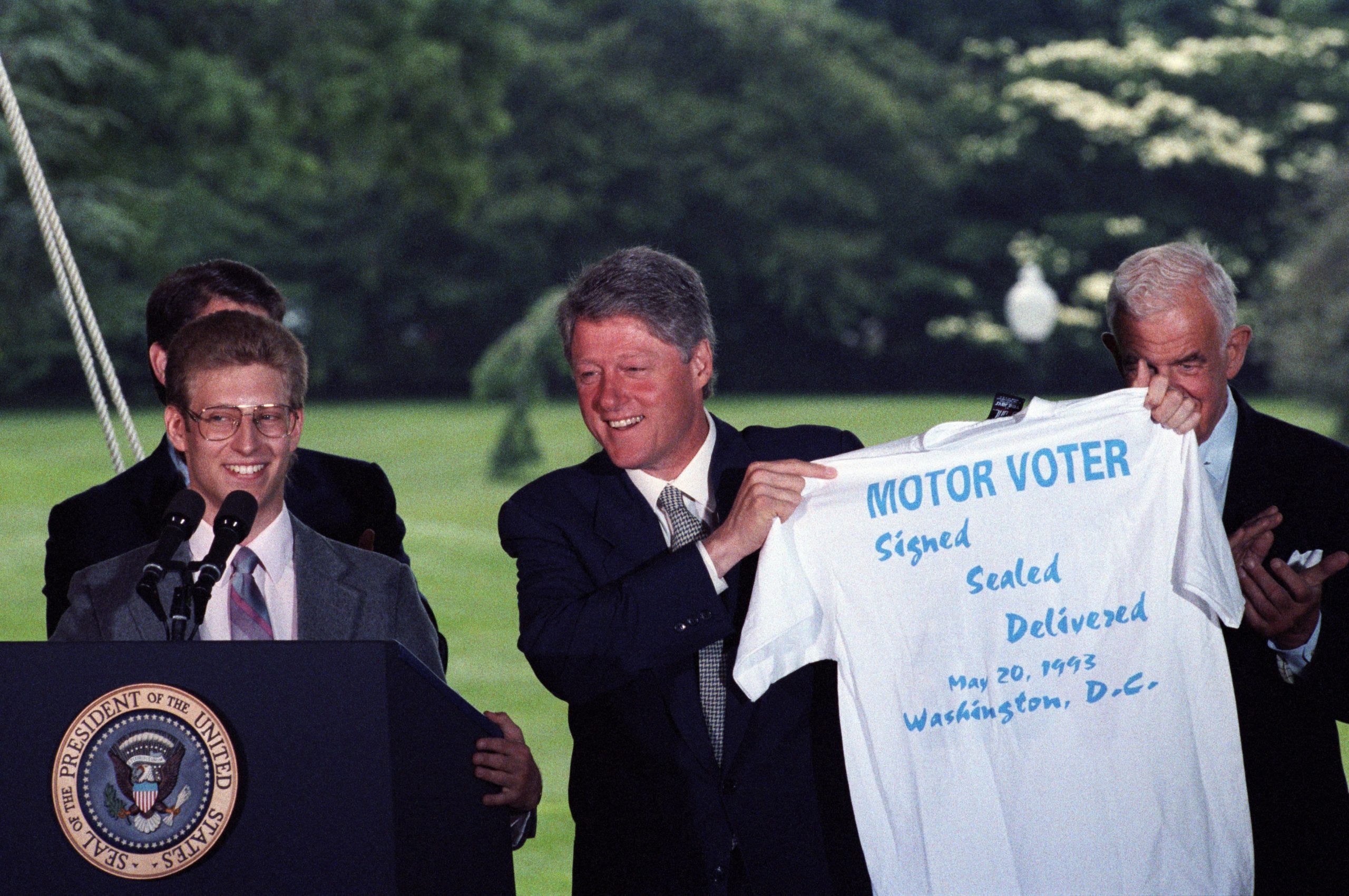
The League of Women Voters of Mississippi, the Mississippi Immigrants Rights Alliance, Mississippi Votes and several other organizations served notice to the Secretary of State’s Office in April that two sections of the state law violate the National Voter Registration Act of 1993 (NVRA), commonly known as the Motor Voter Act. Federal law requires the submission of such a letter before the filing of a lawsuit, along with a waiting period, which in this case has now run its course.
The state is currently running its list of registered voters through a federal immigration database, which means the conflict has gone from a warning about a future law to a live issue. Due to the legal deadline, the coalition must decide whether to sue by early August.
The dispute turns on three points at which the state’s new procedure and the federal law intersect.
The first is the federal registration form. NVRA, which requires states to offer simplified voter registration processes for federal elections, including registration opportunities at motor vehicle agencies and by mail. The law also created a national mail-in form that a citizen may use to register in any state. The form asks the applicant only to swear to citizenship under penalty of perjury. It requires no birth certificate or passport. It was meant to make voting easier, as opposed to ongoing efforts, which do the opposite.
The SHIELD Act makes no exception for people who register using the NVRA form. A voter who submits the form attesting to their citizenship can still be flagged by the state as a result of the database search and required to produce documents the federal form was designed not to demand. That could mean spending time and money—including, for some, long drives to government offices—for legitimate voters, despite the fact that the number of noncitizens who have attempted to vote in Mississippi is vanishingly small.
The second point concerns how voters go about identifying themselves. Federal law lets a person register using the last four digits of their Social Security number in place of a driver’s license number. The text of the SHIELD Act instructs registrars to treat an applicant who provides no driver’s license number, and whose record the state cannot match, as though the state had flagged the applicant as a noncitizen. The applicant is then routed into the federal immigration database for further inquiry. A voter who uses NVRA’s Social Security option is, under the state law, presumed a noncitizen until a database search says otherwise.
There are meanwhile questions about the use of the federal database itself for that purpose. A federal judge in Florida recently ordered the Homeland Security Department to resume allowing four Republican-led states to access federal citizenship data to help screen their voter rolls, contradicting a judge in Washington, D.C. who had ordered the agency to withdraw that access nationally, owing to privacy concerns.
The third point is timing. NVRA bars states from conducting systematic programs to remove voters within 90 days of a federal election—a quiet period meant to keep faulty purges from stripping eligible voters just before they vote. The SHIELD Act acknowledges the rule, providing that a database-based removal may not occur in the 90 days before a federal election. The disagreement is over whether that is enough.
Supporters of laws like Mississippi’s say the quiet period does not apply here at all. The Heritage Foundation, in a 2024 analysis of the same federal provision, argues that the 90-day deadline governs only the removal of eligible voters who have moved, and that removing people who were never eligible, such as noncitizens, falls outside it. According to that reading, a state may strike a suspected noncitizen from the rolls at any time, and the NVRA poses no obstacle.
The challengers answer that the distinction collapses in practice because the databases are wrong often enough to sweep in U.S. citizens. The federal SAVE system was built to check eligibility for public benefits, and its records, which were never designed to be used to verify voters, are incomplete. When the Mississippi Secretary of State’s Office ran the state’s 1.7 million registered voters against its data, the review turned up 15 people with questionable citizenship status, and some of those were flagged in error, according to state Senate Elections Committee chair Sen. Jeremy England (R-Vancleave). A program that produces 15 names from 1.7 million records, the challengers argue, works as a wide net that will snare eligible voters—the harm the quiet period exists to prevent.
The burden of proving a flagging wrong falls on the voter. A person the databases cannot confirm is placed in pending status and must supply proof of citizenship to move out of it.
The groups that served notice of a potential lawsuit point out that the documents the law would require are not evenly held. An estimated 647,000 female citizens in Mississippi have a current name that does not match the one on their birth certificate, according to the Southern Poverty Law Center, and only 20.6 percent of the state’s residents hold a passport, the lowest rate in the country. Older Black Mississippians, some born in an era when the state did not reliably issue birth certificates to Black families, are among those least able to produce the paperwork on demand.
Mississippi requires no documentary proof of citizenship from voters it can confirm through existing records, and the state has reported no prosecutions for noncitizen voting. The law’s defenders say the checks guard against a vulnerability whether or not it has been exploited. Its challengers say the federal registration statute already settled how far a state may go, and that Mississippi has gone past it.
Secretary of State Michael Watson has not said whether the state will change its procedure, and the groups that filed the notice have not said when, or whether, they will sue. The 90-day quiet period before the November federal election begins in early August.
Image: President Bill Clinton celebrates touts the Motor Voter Act at a press event (via Clinton Presidential Library)
